
Calculate Damages for Apartment Accidents: A Step-by-Step Guide
Table of Contents
- Understanding Premises Liability and Your Right to Compensation
- Types of Damages in Personal Injury Cases from Apartment Accidents
- How to Prove Negligence Against a Landlord or Property Owner
- Step-by-Step Process to Calculate Your Damages
- Statute of Limitations for Personal Injury in California
- Evidence Preservation and Documentation Templates
- Common Mistakes to Avoid When Calculating Damages
- Frequently Asked Questions
Last Updated: September 25, 2026
Understanding Premises Liability and Your Right to Compensation
Premises liability is the legal responsibility a property owner has when someone is injured on their property due to negligence. The landlord or property management company may owe you compensation for your injuries and losses. (Source: National Highway Traffic Safety Administration (NHTSA) data)
The key to winning a premises liability case is proving the property owner failed in their duty of care, showing they knew (or should have known) about a hazard and did nothing to fix it or warn you.
Your right to compensation depends on proving the owner had a duty to maintain the property safely, breached that duty, and their negligence directly caused your injury. Understanding how to calculate damages apartment accidents is essential before negotiating with insurers.
Document everything immediately after an accident. Photos of the hazard, witness names, and your injury details become critical evidence later. The longer you wait, the harder it is to prove what caused your fall.
Types of Damages in Personal Injury Cases from Apartment Accidents
Damages are the money you can recover for losses caused by the accident: economic damages (measurable costs) and non-economic damages (pain and suffering).
Economic damages include medical bills, lost wages, and future care costs, you add up receipts and invoices. Non-economic damages cover pain, emotional distress, and lost quality of life, with no receipts to support them.
Economic Damages: Medical Bills, Lost Wages, and Future Care
Economic damages include every dollar you spent or will spend because of the injury. Gather all medical records and bills from hospitals, doctors, physical therapists, and other treatment providers.
Medical expenses to include:
- Emergency room visits and ambulance fees
- Hospital stays and surgical procedures
- Doctor appointments and diagnostic tests
- Physical therapy and rehabilitation
- Prescription medications
- Medical equipment (crutches, braces, wheelchairs)
- Home health care services
Lost wages are the income you couldn’t earn while recovering. If you missed two weeks of work earning $500 per week, that’s $1,000 in lost wages. Include overtime, bonuses, or commissions.
For future care costs, calculate ongoing medical needs. If your doctor prescribes physical therapy for six months at $150 per session, twice weekly, that’s roughly $1,800. Include long-term disability care, ongoing medication, or future surgeries.
The total of all economic damages is your baseline. This number is objective and supported by receipts. Insurance companies often accept economic damages more readily than non-economic damages.
Non-Economic Damages: Pain and Suffering Valuation
Non-economic damages compensate you for physical pain, emotional distress, and reduced quality of life. Courts and insurance companies use formulas to estimate fair amounts.
The multiplier approach multiplies your total economic damages by 1 to 5, depending on severity. Minor injuries use 1.5; serious injuries causing permanent disability use 4 or 5.
Example: If your economic damages total $10,000 and your injury is moderate, multiply by 3. That gives you $30,000 in pain and suffering damages. For severe injuries, the multiplier can be higher.
The per diem approach assigns a daily dollar amount for pain and suffering. If you suffered for 180 days at $50 per day, that’s $9,000 in non-economic damages.
Injury severity, recovery length, and impact on daily life affect your multiplier. Permanent scarring, chronic pain, or lost mobility justify higher multipliers.
How to Prove Negligence Against a Landlord or Property Owner
Proving negligence requires showing four elements: the owner had a duty to maintain the property safely, they breached it, their failure caused your injury, and you suffered real losses.
Establishing Duty of Care and Breach
Property owners must maintain common areas (hallways, stairs, parking lots, entryways) free from hazards and warn residents of dangers they can’t immediately fix.
Breach occurs when the owner fails this duty. Examples include:
- Leaving a spill on the floor for hours without cleaning or warning signs
- Broken stairs or railings that aren’t repaired
- Poor lighting in hallways or stairwells
- Negligent security allowing unauthorized entry or crime
- Failure to maintain walkways (ice, debris, cracks)
The owner’s knowledge matters. If they knew about the hazard or should have known (a reasonable inspection would find it), breach is provable. Apartment owners are expected to inspect common areas regularly.
Documenting Hazards and Negligent Security
Strong evidence includes maintenance records, inspection reports, and prior complaints. Request the property’s maintenance logs to show the owner knew about a hazard and didn’t fix it.
Negligent security claims require showing the owner failed to prevent foreseeable crime (broken locks, missing cameras, inadequate lighting).
Do not clean up or remove the hazard after your injury. The property owner may argue the hazard didn’t exist. Preserve the scene with photos and get witness contact information immediately.
Step-by-Step Process to Calculate Your Damages
Follow these steps to calculate damages apartment accidents and build a complete claim.
Step 1: Document All Medical Expenses and Treatment Records
Gather every medical bill, receipt, and statement related to your injury. Create a spreadsheet listing each provider, date of service, and amount charged.
What to collect:
- Hospital admission and discharge summaries
- Surgical reports and anesthesia bills
- Imaging reports (X-rays, MRI, CT scans)
- Lab work and diagnostic test results
- Physical therapy invoices and progress notes
- Prescription receipts and pharmacy statements
- Travel costs to medical appointments
- Medical equipment purchases
Step 2: Calculate Lost Wages and Loss of Earning Capacity
Document every day you missed work. Request a statement from your employer showing dates missed and wages lost, including overtime and bonuses. (Source: U.S. Bureau of Labor Statistics (BLS) data on wage growth)
Step 3: Assess Future Medical and Rehabilitation Costs
Ask your doctors for a prognosis and get cost estimates from providers for ongoing treatment and procedures.
Step 4: Determine Pain and Suffering Using Recognized Formulas
Use the multiplier method: add your total economic damages (medical bills + lost wages + future costs), then multiply by 1.5 to 5 depending on severity.
Multiplier guidelines:
- Minor injuries (brief recovery, no lasting effects): 1.5 to 2
- Moderate injuries (weeks of treatment, some lasting impact): 2.5 to 3.5
- Severe injuries (months of treatment, permanent effects): 4 to 5
- Catastrophic injuries (permanent disability, chronic pain): 5+
Your total damages = economic damages + non-economic damages. A case with $15,000 in medical bills, $5,000 in lost wages, and a 3× multiplier for pain and suffering totals $60,000 in damages.
Statute of Limitations for Personal Injury in California
In California, you have two years from the date of injury to sue for personal injury damages in apartment complexes.
Evidence Preservation and Documentation Templates
Preserving evidence is critical. Start immediately after the injury, as delays make proof harder.
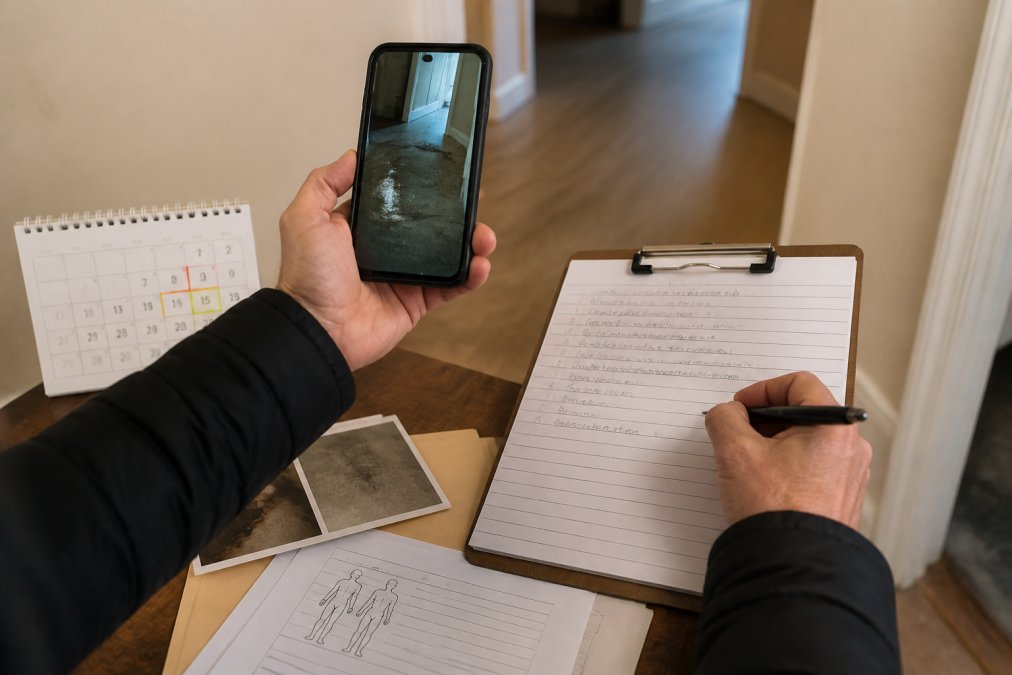
Critical evidence to preserve:
- Photos of the hazard (from multiple angles, showing the full area)
- Photos of your injuries (document healing over time)
- Witness contact information (names, phone numbers, addresses)
- The property’s maintenance records (request from management)
- Security camera footage (request within days of the incident)
- Prior complaints about the same hazard (from other tenants)
- Weather records (if weather was a factor)
- Your medical records and bills
Create a documentation checklist immediately:
| Evidence Type | What to Collect | Timeline |
|---|---|---|
| Scene photos | Multiple angles of hazard, full area view | Within 24 hours |
| Injury photos | Close-ups showing visible injuries | Daily for 2 weeks |
| Witness info | Names, phone, addresses, what they saw | Within 48 hours |
| Medical records | All bills, reports, prescriptions | Ongoing |
| Maintenance logs | Property repair history | Within 2 weeks |
| Security footage | Video of incident or hazard | Within 7 days |
| Prior complaints | Tenant reports about same hazard | Within 2 weeks |
Common Mistakes to Avoid When Calculating Damages
Underestimating damages is the most common mistake. Many injured people accept the first settlement offer without calculating their true losses. Insurance companies count on this.
Frequently Asked Questions
How do I calculate damages for an apartment complex accident?
Start by documenting all economic losses: medical bills, lost wages, and future care costs. Then assign a value to non-economic damages like pain and suffering using the multiplier method (typically 1.5 to 5 times your economic damages) or the per diem method (a daily rate for your suffering). Add any punitive damages if the landlord’s negligence was willful. Preserve all evidence, including accident reports, medical records, and proof of the property owner’s negligence. Consult an attorney to ensure your calculation accounts for comparative negligence rules in your state.
What types of damages can I recover in a personal injury case from an apartment accident?
You can recover economic damages (medical expenses, lost wages, rehabilitation costs, future earning capacity) and non-economic damages (pain and suffering, emotional distress, loss of enjoyment of life). In rare cases involving gross negligence or intentional conduct, punitive damages may be available. The total depends on the severity of your injury, the landlord’s degree of negligence, and whether comparative negligence applies. An attorney can help identify all compensable losses specific to your case.
How do I prove negligence against a landlord for an apartment accident?
Establish four elements: (1) the landlord had a duty of care to maintain safe premises, (2) they breached that duty through action or inaction, (3) your injury was caused by that breach, and (4) you suffered damages. Document the hazard (poor lighting, broken stairs, inadequate security), gather witness statements, obtain the accident report, and preserve photos of the unsafe condition. Show the landlord knew or should have known about the hazard. Medical records linking your injury to the accident strengthen your case. Professional documentation and legal guidance are critical to proving fault.
What is the statute of limitations for filing a personal injury claim in California?
In California, you generally have two years from the date of injury to file a personal injury lawsuit. For property damage claims, the limit is three years. Missing this deadline bars your claim entirely, so act quickly. Certain circumstances (such as the plaintiff being a minor or the defendant concealing their identity) may extend the deadline. Do not delay in gathering evidence or consulting an attorney, as insurance settlement negotiations may take months and you must preserve your legal right to sue.