
California Comparative Negligence Laws for Accident Victims
Table of Contents
- What Is Pure Comparative Negligence?
- How Is Fault Determined in a Car Accident?
- Pure Comparative Negligence vs Modified Comparative Negligence
- Personal Injury Settlement Calculation Examples
- How Insurance Companies Assign Fault Percentages
- What to Do If You Disagree With Your Fault Percentage
- Get a Free Consultation
- Frequently Asked Questions
Last Updated: September 4, 2026
What Is Pure Comparative Negligence?
Pure comparative negligence is the legal rule in California that allows an injured person to recover damages even when they are partially at fault for their own accident. Under this system, your financial compensation is reduced by your exact percentage of fault, no matter how high that percentage climbs (leginfo.legislature.ca.gov). This guide from Abkarian Law Group explains how these laws work so you understand your rights after a personal injury claim.
The core principle is straightforward: fault is divided among everyone involved, and each party pays only for their share. If you are found 10% at fault, your recovery drops by 10%. If you are found 90% at fault, you can still recover the remaining 10% of your damages. This makes California one of the most plaintiff-friendly states in the nation for negligence claims.
This matters because the financial difference between a finding of 20% fault versus 40% fault can be tens of thousands of dollars.
How Is Fault Determined in a Car Accident?
Fault in a car accident is determined by examining each driver’s actions against what a reasonably careful person would have done. Investigators review the sequence of events, violated traffic laws, and physical evidence to assign a precise fault percentage to each party.
California applies the duty of care concept from tort law to evaluate each driver’s behavior. A driver who ran a red light breached their duty, but the other driver who was speeding may also share responsibility, meaning both parties can bear liability.
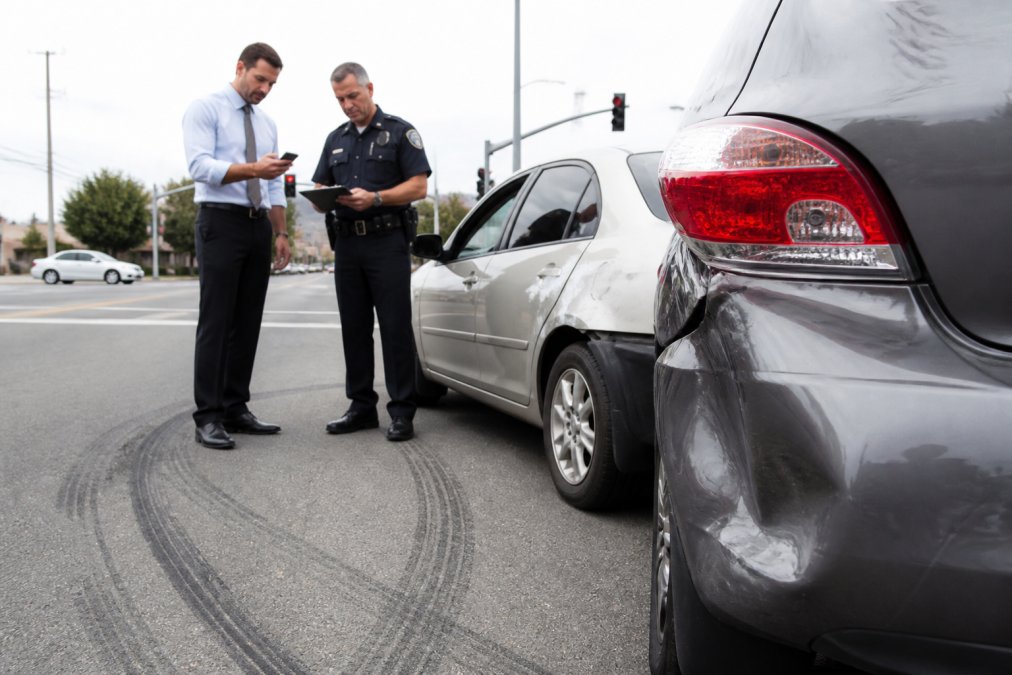
Evidence That Shapes the Fault Decision
The evidence gathered after a crash becomes the foundation for any fault allocation. Police reports document officer observations and citations. Photographs capture vehicle positions, damage patterns, and road conditions.
Witness statements provide independent accounts. In complex cases, accident reconstruction experts analyze skid marks, impact angles, and vehicle data. Adjusters and attorneys weigh this evidence to determine fault percentages before settlement negotiations.
The Role of Expert Witnesses in Fault Disputes
Most guides stop at listing evidence types, but the real battle over fault percentages often happens through expert witnesses. When evidence is ambiguous, both sides hire specialists to shift fault percentages in their favor.
Accident reconstructionists are the most influential experts in contested claims. They use physics-based analysis to determine speeds, impact points, reaction times, and evasive actions. For example, if the other driver claims you slammed on your brakes, a reconstructionist can analyze skid marks to estimate your deceleration rate, potentially undermining the other side’s argument.
Biomechanical engineers enter when injury severity is disputed, analyzing crash forces to determine if the impact could cause the claimed injuries. This matters because minimal vehicle damage may lead an adjuster to argue your injuries are exaggerated.
Medical experts play a different role. When you have pre-existing conditions or a treatment gap, the defense may argue your injuries were not accident-related. A physician can provide testimony connecting the crash to your diagnosis, preserving your damages’ full value.
Expert witnesses are not cheap, which is why most personal injury attorneys front the cost and recover it from the settlement. Their reports carry significant weight because insurers know a credible expert can sway a jury. In disputed cases, expert quality often determines whether you are assigned 30% fault or 10%.
If the insurance company hires an expert to challenge your version of events, you have the right to hire your own. Most contingency-fee attorneys will cover expert costs upfront and deduct them from the final settlement.
Pure Comparative Negligence vs Modified Comparative Negligence
The critical difference between pure and modified comparative negligence is whether a fault threshold blocks recovery entirely. California follows the pure rule, allowing recovery even at 99% fault. Most other states bar recovery once fault reaches 50% or 51%.
Under a modified system, a plaintiff found 51% at fault receives nothing. This distinction matters because it affects how aggressively insurers negotiate when they believe you share blame.
| Fault System | Maximum Fault for Recovery | Example Outcome |
|---|---|---|
| Pure Comparative (California) | 100% | 80% at fault recovers 20% of damages |
| Modified (50% bar) | 49% | 50% at fault recovers nothing |
| Modified (51% bar) | 50% | 51% at fault recovers nothing |
| Contributory Negligence | 0% | Any fault at all bars recovery |
States following pure comparative negligence are in the minority. California Civil Code section 1714 codifies this approach, meaning partial blame does not eliminate your right to compensation (leginfo.legislature.ca.gov).
Personal Injury Settlement Calculation Examples
To calculate a settlement under pure comparative negligence, start with total damages, economic damages like medical bills and lost wages, plus non-economic damages for pain and suffering, then subtract your fault percentage.
Consider $100,000 in total damages. At 25% fault for failing to yield, your recovery drops to $75,000. The same accident in a modified state would produce the same result, but at 50% fault, recovery falls to zero.
Another example: a rear-end collision with $40,000 in medical expenses. If the other driver claims you stopped suddenly, making you 10% at fault, your settlement becomes $36,000. Every percentage point of fault directly reduces your compensation.
How Insurance Companies Assign Fault Percentages
Insurance adjusters assign fault percentages based on their evidence interpretation, but their primary goal is minimizing payouts. They analyze the police report, damage patterns, and traffic laws to build a case for your fault. Their initial assessment is a starting point for negotiation, not a final determination.
A common tactic is inflating your fault percentage early, hoping you accept a reduced settlement. Adjusters may emphasize any contributing factor, like speeding slightly or failing to signal, to shift liability. This is where legal representation becomes critical.
The burden of proof rests with each party to demonstrate the other’s negligence. Insurers know most victims lack resources to dispute findings, so they present assessments as final. Understanding this helps you prepare for pushback.
How Adjusters Actually Calculate Fault
Insurance adjusters do not use a scientific formula to assign fault. They rely on internal guidelines, state traffic laws, and professional judgment. Most major insurers use claims software that flags liability issues, but the final percentage is a human decision.
A typical adjuster starts with a baseline assumption (insurance.ca.gov). In a rear-end collision, the default is that the following driver is 100% at fault because California Vehicle Code section 21703 requires a safe following distance. The adjuster then looks for mitigating factors, like a sudden stop without brake lights or an illegal lane change.
In intersection collisions, the analysis is more complex. The adjuster reviews right-of-way rules, signal timing, and impact points. If one driver ran a red light but the other was speeding, the adjuster might assign 80% fault to the light runner and 20% to the speeder. These numbers come from the adjuster’s experience, not any statute.
The Negotiation Sequence You Should Expect
Insurance companies follow a predictable pattern when they believe you share fault. Understanding this sequence helps you know when to push back.
Step one: The initial assessment. Within a few weeks, the adjuster calls with their fault determination, referencing specific evidence like a police report notation. This call gauges whether you will accept their number without argument.
Step two: The first settlement offer. If you do not accept the assessment, the adjuster makes a low offer reflecting their assigned fault percentage, almost always below your claim’s true value. This tests whether you understand the law and have representation.
Step three: The evidence exchange. If you push back, the adjuster asks for your evidence, photos, witness statements, expert reports, and shares theirs. This exchange is the most critical moment because it determines whether the fault percentage shifts.
Step four: The revised assessment. After reviewing your evidence, the adjuster may adjust the fault percentage, often by 10 to 20 points with a well-documented challenge. With an attorney, this revision often happens without direct argument.
Never accept an insurance company’s fault assessment at face value. Once you agree to a percentage of fault in writing, you may waive your right to challenge it later, permanently reducing your financial compensation.
Why the Initial Assessment Is Almost Always Negotiable
The initial fault assessment is rarely the adjuster’s honest opinion of what a jury would decide. It is a strategic opening position designed to leave room for negotiation, since most claimants accept a settlement rather than file a lawsuit.
If you challenge the assessment with solid evidence, the adjuster must weigh litigation risk. Juries are unpredictable, and insurers generally prefer settling within their authority rather than risking a verdict exceeding their reserve. This gives you leverage when your evidence is strong.
A common pattern is for adjusters to reduce fault assessments by 10 to 15 percentage points when challenged by an attorney. For a $100,000 claim, that shift represents $10,000 to $15,000 more. This is why experienced attorneys almost always challenge initial assessments.
What to Do If You Disagree With Your Fault Percentage
If you believe the insurance company assigned you too much fault, you have the right to dispute it. Gather additional evidence supporting your version of events, including traffic camera footage, witness contact information, and your own photographs. Documentation contradicting the adjuster’s theory can shift the allocation.
Be careful what you say to the adjuster. Statements like “I didn’t see the other car” or “I’m sorry, I should have been more careful” can be interpreted as admissions increasing your fault. Stick to the facts and avoid speculating.
Never accept an insurance company’s fault assessment at face value. Once you agree to a percentage of fault in writing, you may waive your right to challenge it later, permanently reducing your financial compensation.
When negotiations stall, an experienced personal injury attorney can intervene. Attorneys present evidence effectively and bring in expert witnesses when reconstruction is needed. Legal representation often leads to more favorable fault allocations and higher offers.
Get a Free Consultation
Disputing a fault assessment on your own can be overwhelming while recovering from injuries. At Abkarian Law Group, we handle the negotiation process so you can focus on healing. Our team has over 34 years of experience and a 99% success rate on accepted cases.
We operate on a contingency-fee basis, meaning you pay nothing upfront unless we win. Our bilingual staff serves clients in English, Armenian, Spanish, and Farsi, and we are available around the clock. We provide personalized case management by senior attorneys rather than passing your case to junior associates.
Your percentage of fault directly determines your financial recovery under California’s pure comparative negligence rule. An experienced [attorney can](/is-it-worth-hiring-personal-injury-lawyer-california/) challenge unfair fault assessments and maximize the compensation you receive.
Frequently Asked Questions
Does California use a 50% or 51% bar for negligence claims?
California does not use a 50% or 51% bar. It follows a pure comparative negligence rule under Civil Code section 1714. This means you can recover damages even if you are 99% at fault. Your financial compensation is reduced by your exact percentage of fault, so a 99% at-fault driver can still recover 1% of their damages.
Can I recover damages if I am 90% at fault for an accident?
Yes. Under California’s pure comparative negligence rule, a 90% at-fault party can still recover 10% of their total damages. For example, if your economic and non-economic damages total $100,000 and you are 90% at fault, you can recover $10,000. This differs from modified comparative negligence states, where fault at or above 50% or 51% bars recovery entirely.
How is fault determined in a personal injury case?
Fault is determined by examining evidence including police reports, witness statements, photos, traffic camera footage, and data from vehicle event recorders. Insurance adjusters and attorneys review these materials to assign a percentage of fault to each party. In disputed cases, accident reconstruction experts may be called to analyze the crash dynamics and support a specific fault allocation.
How does partial fault affect my personal injury settlement?
Your settlement amount is reduced by your percentage of fault. If an insurance adjuster assigns you 30% fault, your total damages are multiplied by 70%. This is why disputing an unfair fault assessment matters. An experienced personal injury attorney can present counter-evidence to negotiate a lower fault percentage and maximize your recovery.
Getting injured in an accident is stressful enough without fighting insurance companies over who is to blame. Understanding comparative negligence laws gives you leverage, but applying them effectively requires experience. Contact Abkarian Law Group for a free consultation and let us put our track record to work on your personal injury claim.
This article was written using GrandRanker