
DTLA Law Group vs Wilshire Law Firm: Compare
Table of Contents
- Overview: DTLA Law Group vs Wilshire Law Firm
- Practice Areas and Legal Services
- How to Choose a Personal Injury Lawyer: Key Criteria
- Understanding Contingency Fee Agreements Explained
- Law Firm Disciplinary Records and Regulatory History
- Case Results, Track Record, and Client Advocacy
- Which Firm Is Right for You?
- Conclusion
Last Updated: August 13, 2026
Overview: DTLA Law Group vs Wilshire Law Firm
When you’re injured and facing mounting medical bills, the choice of personal injury attorney can determine whether you recover fair compensation or settle for far less. DTLA Law Group vs Wilshire Law Firm represents a decision between two prominent Southern California firms, each claiming expertise in personal injury litigation and client advocacy. Both operate on contingency fee models, meaning no upfront costs, but their track records, service models, and client experiences differ significantly.
The question isn’t just "which firm is bigger?" It’s "which firm will actually fight hardest for my case?" This comparison cuts through the marketing claims to examine what matters: disciplinary history, case results, fee transparency, and how each firm treats clients during the legal process.
At Abkarian Law Group, we’ve analyzed how personal injury firms differ in their approach to client representation, settlement strategy, and trial readiness. Understanding these differences helps you avoid choosing a firm that cherry-picks easy cases while dropping complicated ones, or worse, pressures you into accepting lowball settlements just to close cases quickly.
Below, we’ll examine the key criteria that separate competent personal injury representation from exceptional advocacy.
Practice Areas and Legal Services
DTLA Law Group focuses primarily on personal injury cases, including car accidents, slip-and-fall injuries, and wrongful death claims. Their marketing emphasizes high-volume case handling and quick settlements. The firm operates across multiple Southern California locations and processes cases through a standardized workflow designed for efficiency.
Wilshire Law Firm similarly concentrates on personal injury litigation, with additional focus on employment law and business disputes. Their service model combines personal injury work with broader legal advocacy, allowing clients to address multiple legal issues through a single firm. This broader practice scope can be advantageous for clients with complex circumstances, injury plus wage theft, for example, but it also means resources are divided across different practice areas.
Abkarian Law Group distinguishes itself by maintaining three distinct practice areas: personal injury, business law, and entertainment law. This structure means personal injury clients work with attorneys whose entire focus is injury litigation, not attorneys splitting time between personal injury and employment disputes. The firm’s 34 years of experience concentrates specifically on injury cases, medical malpractice, and complex liability claims, not a secondary practice area added to boost revenue.
The distinction matters. When your slip-and-fall case involves disputed liability and requires expert witness testimony, you want an attorney whose daily work involves exactly that scenario, not someone who handles slip-and-falls on Tuesdays and employment contracts on Wednesdays.
How to Choose a Personal Injury Lawyer: Key Criteria
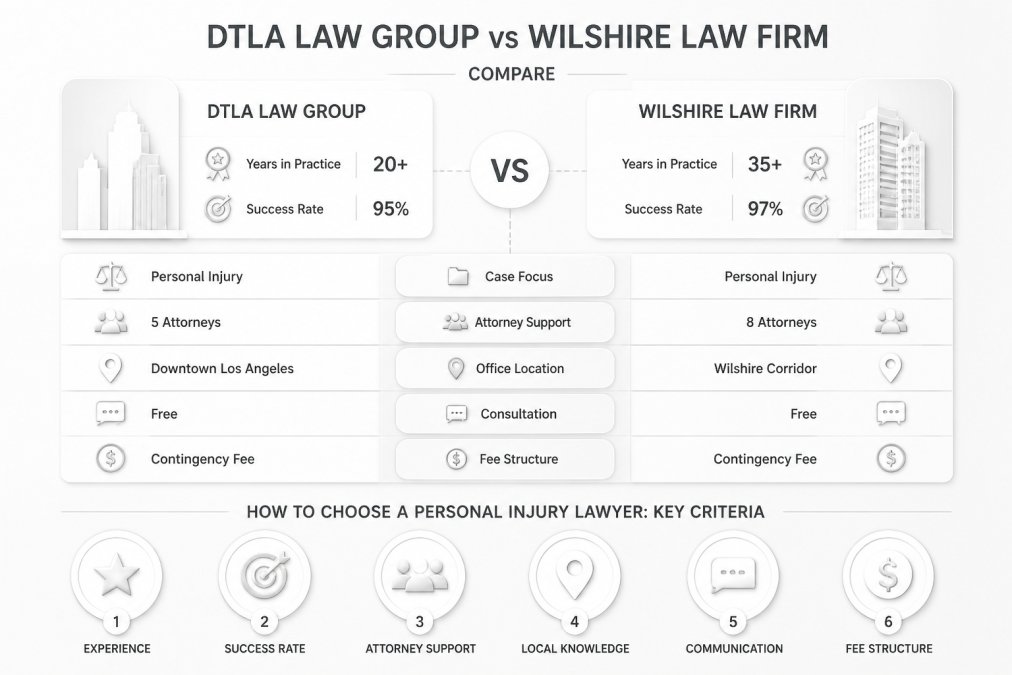
Selecting a personal injury attorney requires evaluating five concrete factors that predict case outcomes. Generic online reviews tell you whether someone answered the phone; these criteria tell you whether they’ll win your case.
Success Rate on Accepted Cases
The most revealing metric is not "how many cases has this firm taken" but "what percentage of cases they accept actually result in favorable settlements or verdicts." High-volume firms often tout case counts while hiding acceptance rates. A firm that accepts 80% of inquiries but wins only 40% of cases is less selective than one accepting 20% but winning 95%.
Abkarian Law Group maintains a 99% success rate on accepted cases, meaning the firm is extremely selective about which cases it takes. This reflects a deliberate strategy: turn down cases unlikely to generate strong compensation, then fight aggressively for the cases accepted. It’s the opposite of high-volume mills that take everything and settle most for minimal recovery.
Trial Experience vs. Settlement Pressure
Many personal injury firms settle 95%+ of cases without trial, which sounds efficient until you realize it often means clients accept less money rather than wait for trial. The insurance company knows which firms lack trial experience and lowballs accordingly.
Ask directly: "What percentage of your cases go to trial?" and "In the past two years, what was your average jury verdict compared to your average settlement?" If the firm hesitates or changes the subject, they’re settlement-focused, not litigation-focused.
Abkarian Law Group maintains over 25 years of trial experience, which signals to insurance adjusters that the firm will actually litigate if settlement offers are inadequate. This credibility alone increases settlement offers because the other side knows you’re not bluffing.
Fee Structure Transparency
Contingency fee agreements should be straightforward: the firm takes a percentage (typically 33% for pre-trial settlements, 40% for trials) only if you win. But some firms bury hidden costs, expert witness fees, court filing fees, deposition transcripts, that get deducted before you see your settlement.
Request a written fee agreement that specifies exactly which costs are the firm’s responsibility versus yours. Legitimate firms provide this upfront. Firms that dodge the question are hiding something.
Bilingual Representation
If English isn’t your first language, "bilingual representation" should mean a fluent attorney who handles your case directly, not a translator brought in for appointments. Many firms claim bilingual capability while actually employing only one Spanish-speaking attorney who’s overbooked.
Abkarian Law Group maintains bilingual staff (English, Armenian, Spanish, Farsi) across the firm, meaning you work with an attorney fluent in your language, not a translator managing communication delays.
Availability and Responsiveness
Personal injury cases move quickly. Insurance companies issue settlement demands with short deadlines. You need to reach your attorney when decisions must be made, not wait three days for a callback.
Ask: "Will I work with the same attorney throughout my case, or will I be transferred to different people?" and "What’s the typical response time for client calls?" Firms that can’t guarantee attorney continuity or same-day callbacks are too large or too disorganized to serve your case well.
Understanding Contingency Fee Agreements Explained
A contingency fee agreement is a contract stating the firm receives payment only if you win your case. This structure eliminates upfront costs for clients, critical for injured people unable to pay legal fees while recovering. However, the agreement’s details determine whether you keep most of your settlement or watch it disappear in fees and costs.
How Contingency Fees Work
The firm advances all costs: filing fees, expert witness testimony, medical record retrieval, deposition transcripts, and investigation expenses. These costs accumulate quickly in serious injury cases. If you lose, you owe nothing. If you win, the firm deducts its percentage and all advanced costs before paying you.
Example: You settle for $100,000. The firm’s contingency fee is 33% ($33,000). Costs totaled $8,000. You receive $59,000. The firm keeps $41,000 total.
Common Hidden Costs
Some firms charge clients for costs even in contingency arrangements. Read carefully:
- Expert witness fees (can exceed $5,000 per expert)
- Court filing and service fees
- Medical record retrieval
- Deposition transcripts
- Investigator fees
- Jury consultant fees
Legitimate firms cover these costs and deduct them from the settlement. Predatory firms bill clients separately, reducing net recovery even after winning.
Why Contingency Fees Align Incentives
Contingency agreements theoretically ensure your attorney’s interests match yours, the firm only profits if you win. In practice, this creates pressure to settle quickly rather than litigate. A firm that settles 100 cases at $50,000 each makes $1.65M (at 33%) with minimal trial work. The same firm fighting 20 cases to trial at $200,000 each makes $2.64M but invests vastly more time and resources.
This explains why many firms push settlement: it’s more profitable per attorney hour, even if it pays you less total compensation.
Law Firm Disciplinary Records and Regulatory History
Disciplinary records reveal whether an attorney has faced complaints for ethical violations, fee disputes, or client abandonment. The State Bar maintains public records showing every disciplinary action against licensed attorneys.
What to Look For
Check State Bar of California disciplinary records for complaints against any firm’s attorneys. Common violations include:
- Failure to communicate with clients
- Mishandling of client funds
- Conflicts of interest
- Fee disputes
- Abandonment of cases mid-litigation
A single complaint doesn’t disqualify an attorney, frivolous complaints happen. Multiple complaints about the same issue (e.g., fee disputes) signal a pattern.
Firm Reputation vs. Individual Attorney Record
Large firms sometimes shield individual attorneys’ disciplinary histories. Request not just the firm’s record but the personal records of the specific attorney handling your case. You’re hiring an individual attorney, not a brand name.
Abkarian Law Group’s longevity, 34 years in business, combined with recognition by Super Lawyers and Forbes legal rankings, suggests consistent ethical practice. Firms that survive that long without major disciplinary actions have institutional discipline and client satisfaction systems in place.
Settlement Pressure and Ethics
Some firms face complaints for pressuring clients into settlements below market value. These complaints often emerge years later when clients discover they settled for far less than comparable cases recovered. This is technically legal but ethically questionable, the attorney’s duty is zealous advocacy, not minimizing their own litigation costs.
Case Results, Track Record, and Client Advocacy

Case results matter more than marketing claims. A firm that recovered $50M across 500 cases (averaging $100K per case) is less effective than one recovering $25M across 100 cases (averaging $250K per case). The second firm negotiated better settlements or won larger verdicts.
Evaluating Published Results
Reputable firms publish case results transparently: case type, injury severity, and settlement or verdict amount. Vague claims ("We’ve recovered millions!") hide the actual per-case averages.
Ask for specific examples matching your injury type. If you have a slip-and-fall case, request three slip-and-fall results from the past 18 months. If the firm can’t provide specific comparable cases, they either don’t have them or don’t want you to see them.
Trial Verdicts vs. Settlements
Jury verdicts are public record and can be verified through court databases. Settlement amounts are confidential unless the client agrees to disclose them. Firms that cite only jury verdicts while hiding settlement data are cherry-picking results.
The best firms show both, with context: "Our average jury verdict in serious injury cases is $450K. Our average settlement in similar cases is $280K. We recommend trial when insurance offers fall below $300K."
Client Advocacy Beyond Settlement
True client advocacy means fighting for maximum compensation, not just closing cases. This includes:
- Refusing inadequate settlement offers even if it delays case resolution
- Hiring expert witnesses to strengthen liability or damages arguments
- Conducting thorough investigation rather than relying on insurance company findings
- Explaining settlement offers clearly so clients make informed decisions, not pressured ones
Firms that maximize client recovery build reputations that generate referrals. Firms that prioritize case volume build reputations for quick settlements and lower-than-deserved payouts.
Which Firm Is Right for You?
The choice between DTLA Law Group and Wilshire Law Firm depends on your specific circumstances and priorities.
Choose DTLA Law Group if: You want a high-volume firm that prioritizes quick resolution, you have a straightforward injury case with clear liability, and you value fast case closure over maximum settlement negotiation. The firm’s efficiency model works well for uncomplicated slip-and-fall or minor car accident cases where liability is obvious and damages are moderate.
Choose Wilshire Law Firm if: You need a firm handling multiple legal issues (injury plus employment dispute, for example) and prefer consolidating legal representation. The broader practice areas allow integrated strategy across different legal problems.
Choose Abkarian Law Group if: You have a complex injury case requiring aggressive litigation, you need bilingual representation in Armenian, Spanish, or Farsi, and you prioritize maximum compensation over quick settlement. The firm’s selective case acceptance (99% success rate) and 34 years of injury-specific experience mean you’re working with attorneys whose entire focus is injury litigation, not a secondary practice area. The 24/7 availability and personalized case management by senior attorneys ensure you’re not handed off to junior associates once you sign the retainer.
The critical question: Do you want the fastest resolution, or the highest compensation? These aren’t always the same outcome.
Choosing the right personal injury attorney determines whether you recover fair compensation or accept less than your case deserves. The decision requires evaluating track records, fee transparency, and attorney availability, not just brand recognition or online reviews.
Abkarian Law Group brings 34 years of injury litigation experience, a 99% success rate on accepted cases, and bilingual representation across multiple languages. If you’re facing a complex personal injury claim and need an attorney committed to aggressive advocacy rather than quick settlements, get a free consultation and discuss your specific circumstances with a senior attorney who focuses exclusively on injury cases. The firm’s contingency fee model means you pay nothing unless you recover compensation, and the initial case evaluation is free.
Frequently Asked Questions
What should I look for when choosing a personal injury lawyer?
Focus on trial experience, success rate on accepted cases, and whether they work on contingency. Verify their state bar standing and disciplinary history through official state bar records. Ask about their specific experience with your type of injury claim, slip-and-fall, auto accident, or workplace injury. Ensure you understand their fee structure upfront and that they offer personalized attention, not just junior associate handling. Client testimonials and peer recognition matter, but verify credentials independently rather than relying solely on firm claims.
How do I verify the disciplinary history of a law firm?
Contact your state bar association directly, they maintain public disciplinary records for all licensed attorneys. Search the State Bar of California's website for any complaints, suspensions, or ethics violations. You can also check the American Bar Association's resources and Avvo, which aggregates disciplinary information. Request specific details about any past complaints and their outcomes. A clean record doesn't guarantee quality, but a history of complaints is a red flag. Always verify directly with the state bar rather than trusting a firm's self-reported history.
What is a contingency fee agreement, and how does it work?
A contingency fee agreement means your attorney only gets paid if you win your case or reach a settlement. The firm covers upfront costs and receives a percentage of your award or settlement, typically 25-40% depending on the case complexity and stage of litigation. You pay nothing if you lose. This aligns the lawyer's interests with yours and removes financial risk for clients without upfront capital. Always review the exact percentage, what costs are deducted, and whether the fee applies to the gross or net settlement before signing.
Is DTLA Law Group a reputable firm?
DTLA Law Group operates in Southern California and handles personal injury and employment law cases. Reputation depends on specific metrics: state bar standing, disciplinary history, case results, and client reviews. Check their California bar record for any complaints or sanctions. Review independent client feedback on Google, Yelp, and Avvo rather than relying only on testimonials on their website. Compare their track record on cases similar to yours. No firm is universally 'the best', reputation is relative to your specific needs and case type.
What are the typical costs for a personal injury lawyer?
Most personal injury lawyers work on contingency, meaning no upfront fees. When they win, they take a percentage of your settlement or award, typically 25-40%. The exact percentage depends on case complexity, whether it settles before trial, and how far litigation goes. Some firms charge higher percentages for cases that require trial. Always ask for a written fee agreement detailing the percentage, what costs are deducted, and any expenses you might owe if you lose. Compare fee structures across firms, but don't choose based solely on the lowest percentage.
This article was written using GrandRanker