
Hardest Injuries to Prove in Court: A Legal Guide
Table of Contents
- What Makes an Injury Hard to Prove
- Soft Tissue Injuries: The Invisible Damage
- Traumatic Brain Injuries and Cognitive Deficits
- Proving Soft Tissue Injury in Court
- How to Document Evidence After a Slip and Fall
- How to Prove Emotional Distress in a Lawsuit
- The Role of Medical Records and Expert Witnesses
- Why Insurance Companies Dispute Subjective Symptoms
Last Updated: August 17, 2026
What Makes an Injury Hard to Prove
The hardest injuries to prove lack visible, objective evidence. A broken bone shows on X-rays; soft tissue damage doesn’t appear on standard imaging, creating a legal challenge that separates straightforward cases from complex ones.
Invisible injuries create what attorneys call the "credibility gap." Insurance adjusters scrutinize these claims heavily because subjective symptoms, pain, cognitive difficulties, emotional distress, lack the tangible markers juries instinctively trust. Without proper documentation connecting the accident to the injury, proving causation becomes nearly impossible.
At Abkarian Law Group, we’ve represented clients whose hardest injuries to prove were dismissed or undervalued by insurance companies. The difference between a failed claim and a successful settlement often comes down to thorough documentation from day one.
Start documenting immediately after an injury occurs, even if symptoms seem minor. Insurance companies are more likely to dispute claims when documentation gaps exist between the accident date and when medical treatment began.
Soft Tissue Injuries: The Invisible Damage
Soft tissue injuries, sprains, strains, and contusions to muscles, ligaments, and tendons, represent the most common personal injury claim and the hardest to prove. Standard diagnostic imaging doesn’t show them clearly, and insurance companies exploit this uncertainty.
Whiplash exemplifies the documentation challenge. Sudden acceleration or deceleration causes the neck to move violently, stretching and tearing soft tissue. The person experiences pain and limited mobility, yet an X-ray shows nothing abnormal. Proving it requires medical records documenting the mechanism of injury, symptom progression, and treatment response.
Insurance adjusters frequently dispute soft tissue claims using the "minimal impact" defense, arguing the accident’s impact was too minor to cause injury. This contradicts biomechanical evidence, low-velocity collisions absolutely cause soft tissue damage. Overcoming this defense requires expert testimony explaining how soft tissue injuries occur independent of impact severity.
Soft tissue injuries developing symptoms within hours of an accident are easier to connect causally to the incident. Symptoms appearing days later invite skepticism. Immediate medical evaluation is critical; it establishes the timeline and creates a documented record linking the accident to the injury.
Soft tissue injuries are difficult to prove because they’re invisible and don’t appear on standard imaging. Documentation establishing the injury mechanism, immediate symptoms, and consistent treatment becomes your evidence.
Traumatic Brain Injuries and Cognitive Deficits
Traumatic brain injuries (TBIs) represent a different category of hardest injuries to prove. A severe TBI with loss of consciousness is straightforward to document. A mild or moderate TBI where the person never lost consciousness creates enormous proof challenges.
Cognitive deficits from TBI include memory problems, difficulty concentrating, slower processing speed, and executive function impairment. These symptoms are subjective, a person reports they can’t focus at work, but no brain scan shows the damage responsible. Neuropsychological testing can measure cognitive deficits, but insurance companies often argue the deficits result from depression, anxiety, or pre-existing conditions rather than the TBI.
Proving which specific symptoms resulted from the accident requires expert neuropsychological evaluation and sometimes advanced imaging like diffusion tensor imaging (DTI) or functional MRI. These tests cost thousands of dollars and aren’t always covered by insurance, creating a financial barrier to proving the injury.
Immediate comprehensive evaluation by a neurologist or neuropsychologist is essential for establishing the injury’s connection to the accident.
Proving Soft Tissue Injury in Court
Proving soft tissue injury in court requires establishing that the accident caused the injury and that the injury justifies claimed damages. Insurance companies will concede the accident occurred; they’ll dispute causation and damages.
Establish mechanism of injury through expert testimony. A biomechanics expert can testify that the accident’s speed, direction, and impact were sufficient to cause the claimed injury, directly countering the "minimal impact" defense.
Medical records documenting immediate symptoms form your foundation. The initial examination should show the person reporting pain and limited range of motion. Objective findings, measurable clinical signs like reduced range of motion, muscle spasm, or positive orthopedic tests, carry far more weight than subjective complaints alone.
Treatment consistency matters enormously. Consistent medical treatment demonstrates the injury’s severity and the person’s commitment to recovery. Gaps in treatment invite arguments that the injury wasn’t serious or that the person recovered but continued claiming damages.
Imaging evidence, when available, strengthens your case substantially. An MRI showing soft tissue damage eliminates the "nothing is wrong" defense. Medical expert testimony explaining why the specific injury wouldn’t appear on standard imaging is essential when imaging is negative.
Never delay seeking medical treatment after an accident, even if symptoms seem minor. Insurance companies use treatment gaps to argue the injury wasn’t caused by the accident or wasn’t serious.
How to Document Evidence After a Slip and Fall
Slip and fall injuries exemplify the documentation challenge because these accidents often occur without witnesses. Proper documentation transforms a "he said, she said" scenario into a credible claim.
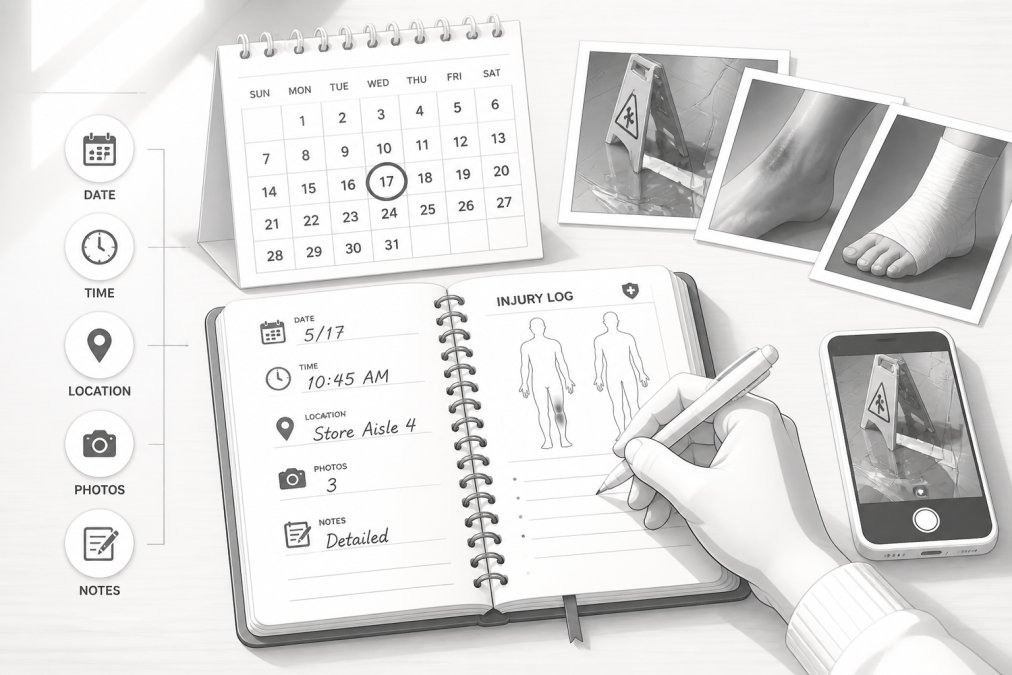
Photograph the scene immediately. Take photos of the hazard that caused the fall from multiple angles and distances. Include environmental context: lighting, signage, nearby exits. Conditions change quickly; property owners might clean up or repair damage within hours.
Photograph your injuries. Take detailed photos of visible injuries on the day of the accident and on subsequent days as they evolve. Injuries often look worse after 24-48 hours as swelling increases and bruising darkens.
Document the timeline. Write down the exact time and date of the fall, what caused it, weather conditions, lighting, and whether you were warned about hazards. Write this immediately while details are fresh.
Collect witness information. If anyone saw the fall, get their name, phone number, and email address immediately. Witness testimony is powerful evidence, but witnesses become unavailable as time passes.
Seek medical evaluation promptly. See a doctor within 24 hours. The medical record establishes the injury’s connection to the accident.
Keep a pain journal. Daily documentation of pain levels, activity limitations, sleep disruption, and emotional impact creates a detailed record of how the injury affected your life.
Preserve evidence. Keep the clothing and shoes you wore during the fall. Damage to these items can corroborate the accident’s severity. Preserve all medical records, receipts, and correspondence with the property owner or their insurance company.
Report the incident formally. If the fall occurred at a business, file an incident report with management immediately and request a copy for your records.
| Documentation Element | Timing | Why It Matters |
|---|---|---|
| Scene photos | Within 24 hours | Preserves evidence before cleanup or repairs |
| Injury photos | Day 1 and days 2-5 | Shows injury progression and severity |
| Written timeline | Same day | Captures accurate details while memory is fresh |
| Witness statements | Within 48 hours | Witnesses remain available and memory is reliable |
| Medical evaluation | Within 24 hours | Establishes injury causation in medical record |
| Pain journal | Daily for 30+ days | Documents ongoing impact and recovery timeline |
| Incident report | Same day | Creates official record of the accident |
How to Prove Emotional Distress in a Lawsuit
Emotional distress claims are among the hardest injuries to prove because emotion is fundamentally subjective. Yet emotional distress is a valid component of personal injury damages.
Two categories exist: negligent infliction of emotional distress (NIED) and intentional infliction of emotional distress (IIED). Both require evidence that the emotional distress is genuine and severe, not merely upset or inconvenience.
Establish baseline mental health with pre-accident medical records. Insurance companies argue current symptoms reflect pre-existing conditions rather than accident-caused distress. Pre-accident records establish your baseline.
Documentation of post-accident emotional symptoms is essential. Anxiety, insomnia, panic attacks, depression, and PTSD are measurable conditions. A mental health professional’s evaluation and diagnosis creates objective evidence of emotional distress.
Behavioral changes provide corroborating evidence. Did you stop activities you previously enjoyed? Did you withdraw from social relationships? Did you experience panic attacks in situations similar to the accident? Written statements from family members, friends, or colleagues describing observed changes carry weight.
Treatment records demonstrate emotional distress severity. Consistent therapy or psychiatric medication over months shows the distress was persistent and significant, not temporary upset.
For emotional distress claims, mental health treatment is essential evidence. Seeking therapy or psychiatric evaluation immediately [after a](/5-best-ways-to-document-evidence-after-a-slip-and-fall/) traumatic accident demonstrates your distress is genuine and serious.
The Role of Medical Records and Expert Witnesses
Medical records form the evidentiary foundation for proving hardest injuries to prove. They document the injury’s existence, severity, causation, and impact on your life. Insurance companies scrutinize medical records intensely, looking for gaps, inconsistencies, or language suggesting the injury wasn’t caused by the accident.

The initial medical evaluation is critical. The emergency room or urgent care note should document how the accident occurred, what injuries resulted, and what symptoms the person reported. Specific, detailed documentation is far more valuable than generic notes.
Ongoing medical records track treatment and recovery. Each follow-up visit should document current symptoms, examination findings, and treatment provided. Consistent documentation showing persistent symptoms supports the claim that the injury is real and ongoing.
Expert witness testimony becomes essential when the injury is complex or when insurance companies dispute causation. A medical expert can explain how the accident caused the injury, why the injury persists, what the prognosis is, and what treatment is appropriate.
Selecting the right expert matters enormously. The expert should have credentials and experience directly relevant to the injury. An orthopedic surgeon testifying about soft tissue injury carries credibility. A neuropsychologist testifying about cognitive deficits from TBI is far more persuasive than a general practitioner.
Expert reports should be detailed and thorough. A comprehensive report explaining the mechanism of injury, the medical findings supporting the diagnosis, how the injury affects the person’s life, and the prognosis creates powerful evidence. If medical records clearly document the injury and its progression, the insurance company’s expert will struggle to credibly argue the injury doesn’t exist or wasn’t caused by the accident.
Why Insurance Companies Dispute Subjective Symptoms
Insurance companies dispute subjective symptoms because subjectivity creates opportunity for settlement reduction. Objective findings, broken bones, visible injuries, positive diagnostic imaging, are difficult to dispute. Subjective symptoms, pain, cognitive difficulties, emotional distress, invite skepticism and negotiation.
Insurance adjusters use several specific tactics. First, they argue the accident’s impact was too minor to cause the claimed injury, citing minimal vehicle damage or low impact speed while ignoring biomechanical evidence. Second, they argue symptom delays prove the injury wasn’t caused by the accident, ignoring that many injuries produce delayed symptoms. Third, they argue pre-existing conditions explain current symptoms, cherry-picking prior medical history. Fourth, they argue the person’s behavior is inconsistent with the claimed injury, pointing to social media photos while ignoring that people with chronic pain often engage in activities despite symptoms.
Overcoming these tactics requires documentation so thorough and consistent that the insurance company’s arguments become implausible. When medical records document immediate symptoms, consistent treatment, objective clinical findings, and expert testimony explaining the injury mechanism, the adjuster’s skepticism loses credibility.
Insurance companies will scrutinize every gap in your documentation. Missing medical appointments, delays in seeking treatment, or inconsistencies in symptom reporting will be used against you. Maintain consistent medical care and detailed documentation throughout your recovery.
Proving the hardest injuries to prove requires understanding how insurance companies think and what evidence they find persuasive. Invisible injuries demand meticulous documentation from the moment the accident occurs. Medical records, expert testimony, and detailed evidence of injury impact transform subjective claims into credible ones.
Abkarian Law Group has successfully litigated cases involving hardest injuries to prove. Our approach combines thorough investigation, expert consultation, and aggressive advocacy to overcome insurance company skepticism. With a 99% success rate on accepted cases and zero-fee representation, we fight for clients whose injuries are real but difficult to prove. Get a Free Consultation to discuss how we can help prove your injury and secure the compensation you deserve.
Frequently Asked Questions
What is the hardest injury to prove in a personal injury case?
Soft tissue injuries, traumatic brain injuries, and psychological trauma are among the hardest injuries to prove because they lack visible objective evidence on standard diagnostic imaging. Insurance adjusters often dispute subjective symptoms like pain and cognitive deficits without corroborating medical documentation. Chronic pain syndrome, whiplash, and PTSD are particularly challenging because they depend heavily on your medical records, testimony, and expert witness analysis rather than clear clinical findings visible on X-rays or CT scans.
Why are soft tissue injuries often challenged by insurance companies?
Soft tissue injuries, sprains, strains, and ligament damage, typically don't show up on standard radiology reports, making them invisible to adjusters. Insurance companies argue that without objective evidence, you cannot prove causation or the extent of damage. This is why detailed medical documentation, diagnostic imaging like MRI scans, and consistent treatment records become critical. Maintaining a pain journal and seeking prompt medical evaluation immediately after an accident significantly strengthens your position against these disputes.
Can you win a personal injury claim without objective medical evidence?
Yes, but it is significantly more difficult. You can win using subjective symptoms supported by strong medical records, consistent medical treatment, credible expert witness testimony, and detailed personal documentation like pain journals. However, the burden of proof shifts heavily onto you. Insurance companies will scrutinize delayed symptom reporting, gaps in treatment, and any inconsistencies in your testimony during deposition. The stronger your documentation and medical support, the better your chances of overcoming the credibility gap.
What role do pain journals and daily logs play in proving difficult injuries?
Pain journals create a contemporaneous record of your symptoms, limitations, and daily impact that corroborates your testimony and medical records. Insurance adjusters and juries find consistent, detailed logs credible because they show you documented your condition in real time, not months later during litigation. Record specific details: pain level, physical limitations, activities you couldn't perform, medications taken, and how symptoms progressed. This evidence directly addresses the credibility gap that insurers exploit when challenging invisible injuries like chronic pain and emotional distress.
This article was written using GrandRanker