
How Long Does a Personal Injury Settlement Take
Table of Contents
- Understanding Personal Injury Settlement Timelines
- Stages of a Personal Injury Lawsuit
- Factors That Influence Settlement Duration
- Average Timeline for Personal Injury Claims
- How Long to Get Paid After Settlement
- When to File a Lawsuit vs. Settle Out of Court
- Common Delays and How to Avoid Them
- Conclusion
Last Updated: August 9, 2026
Understanding Personal Injury Settlement Timelines
Most personal injury cases resolve within 6 months to 2 years, though some settle in weeks while complex disputes involving serious injuries or contested liability can stretch to 3-5 years or longer. At Abkarian Law Group, we’ve guided thousands of clients through personal injury claims. The variation in settlement duration follows predictable patterns based on case structure, injury severity, and how aggressively both sides pursue resolution.
The personal injury settlement process involves distinct stages: medical treatment must reach completion before settlement discussions can conclude, insurance companies need time to investigate and evaluate liability, and negotiation periods expand or contract depending on how far apart the parties stand on compensation.

The biggest delay most claimants encounter isn’t legal, it’s medical. Rushing to settle before your injuries stabilize can leave you with compensation that doesn’t cover long-term treatment. Your attorney should never pressure you to accept a settlement until your doctor confirms maximum medical improvement.
Stages of a Personal Injury Lawsuit
A personal injury claim moves through distinct phases, each with typical timeframes.
Initial Claim Filing and Investigation
The first stage begins when you file a claim with the at-fault party’s insurance company, typically taking 2-4 weeks. Your attorney submits documentation including medical records, accident reports, police reports, and proof of damages. The insurance company has no legal deadline to respond, but most respond within 30 days. The adjuster investigates the accident, reviews liability, and estimates damages. This investigation period can extend 4-8 weeks depending on case complexity.
Your role is straightforward: provide complete medical documentation and maintain detailed records of expenses, lost wages, and impact on daily life. Incomplete documentation extends this phase unnecessarily.
Demand Package and Negotiation Period
Once investigation concludes, your attorney prepares a demand package, a formal document outlining your injuries, medical treatment, financial losses, and requested compensation. The insurance company reviews your demand (typically 2-4 weeks) and responds with a counteroffer. This back-and-forth negotiation can last weeks or months, with most cases seeing 3-5 rounds of counteroffers before settlement discussions become serious.
Most personal injury claims resolve during the negotiation period. If both sides recognize a reasonable settlement range, this phase concludes within 2-3 months. If liability remains disputed or damage estimates diverge significantly, negotiations extend longer.
The negotiation period is where your case’s value gets determined. Skilled negotiators secure settlements 20-40% higher than inexperienced ones.
Mediation and Settlement Agreement
If direct negotiation stalls, mediation becomes the next step. A neutral third party facilitates settlement discussions over 4-8 hours, typically occurring over 1-2 days. Scheduling mediation adds 2-4 weeks to your timeline. Mediation succeeds in resolving 60-70% of personal injury cases. When mediation works, settlement agreement drafting follows within 1-2 weeks.
If mediation fails, your case moves toward litigation and potential trial, extending your timeline significantly.
Factors That Influence Settlement Duration
Medical Treatment and Maximum Medical Improvement
Medical treatment duration is the single largest factor determining settlement timeline. You cannot reasonably settle until your medical condition stabilizes at maximum medical improvement (MMI), when your doctor determines you’ve recovered as much as possible or reached a stable baseline.
Reaching MMI typically takes 3-6 months for minor injuries like whiplash or soft tissue damage, 6-12 months for moderate injuries involving fractures or surgery, and 2-3 years or longer for severe injuries with multiple surgeries or traumatic brain injury. Insurance companies won’t negotiate seriously until your medical treatment concludes. Settling before MMI leaves you vulnerable to unanticipated treatment costs.
Liability Disputes and Fault Determination
Clear liability accelerates settlement. If the at-fault party’s negligence is obvious, settlement discussions move quickly and cases resolve within 3-6 months. Disputed liability dramatically extends timelines. When both parties share fault or causation remains unclear, settlement becomes contentious.
Liability disputes often require expert analysis, accident reconstruction experts for vehicle collisions, medical causation experts to prove the accident caused your injuries, or engineering experts to evaluate product defects. Obtaining expert reports adds 4-8 weeks to your timeline. Complex liability cases frequently require mediation or litigation to resolve, extending settlement timelines to 12-24 months or longer.
Never accept early settlement pressure when liability remains disputed. Insurance companies sometimes lowball early to avoid expert costs. Accepting an undervalued settlement before liability is clearly established leaves you with inadequate compensation.
Case Complexity and Injury Severity
Simple cases with minor injuries settle fastest, within 2-4 months with clear accident, straightforward medical treatment, and obvious damages. Moderate complexity cases involving multiple injuries, several medical providers, or significant lost wages typically settle within 6-12 months. Complex cases with severe injuries, multiple defendants, or significant liability questions extend timelines to 18-36 months or longer.
Injury severity affects settlement value and negotiation intensity. Minor injuries with clear damages settle quickly because both sides see the range clearly. Severe injuries with long-term consequences generate wider settlement ranges, requiring sustained negotiation to close the gap.
Average Timeline for Personal Injury Claims
Simple cases (clear liability, minor injuries): 2-4 months
Moderate cases (some complexity, moderate injuries): 6-12 months
Complex cases (disputed liability, severe injuries): 18-36 months
Litigation cases (trial required): 2-5 years
These timelines assume consistent medical treatment, responsive documentation, and active negotiation. The personal injury settlement process rewards patience. Rushing to accept early offers typically costs you money. Most experienced personal injury attorneys recommend allowing 12 months minimum for claim evaluation before accepting settlement, even in straightforward cases.
How Long to Get Paid After Settlement
Reaching a settlement agreement doesn’t mean immediate payment. Several administrative steps occur between settlement signature and money in your account.
Settlement Agreement Execution
Once both parties agree to settlement terms, your attorney prepares the settlement agreement outlining the settlement amount, payment terms, liability release, and confidentiality provisions. Settlement agreement preparation typically takes 3-7 days. You review the agreement with your attorney before signing, this review is critical as the agreement’s language determines your rights after settlement. Both parties sign the settlement agreement, and the insurance company countersigns within 2-5 business days.
Medical Liens and Subrogation
Before the insurance company releases settlement funds, medical liens and subrogation claims must be addressed. A medical lien is a claim by a healthcare provider or health insurance plan against your settlement. Subrogation is a legal right allowing health insurance companies or government programs like Medicare or Medicaid to recover treatment costs from your settlement.
Identifying and resolving liens and subrogation claims typically takes 2-4 weeks. Your attorney requests lien documentation from all medical providers and insurance plans. Negotiating lien amounts can extend this timeline, as some medical providers accept reduced amounts if paid promptly while others demand full payment.
Disbursement Process and Payment
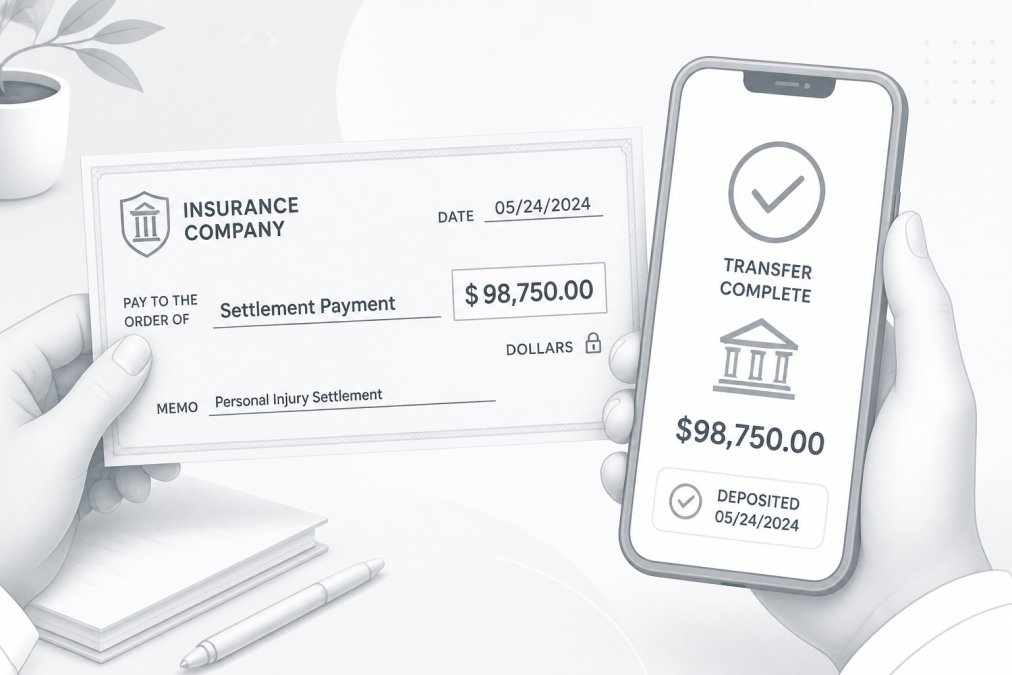
After liens and subrogation claims are resolved, the insurance company initiates payment, typically issuing the settlement check within 7-10 business days of settlement agreement execution. Your attorney’s trust account receives the check and holds funds temporarily while verifying the check clears and finalizing all lien payments, typically 5-10 business days.
Once the check clears and liens are paid, your attorney disburses your portion, usually via direct wire transfer (1-3 business days) or check (3-5 business days). Total time from settlement agreement signature to funds in your account typically ranges 3-4 weeks. Simple cases with minimal liens resolve faster (2-3 weeks), while complex cases with multiple liens take 4-6 weeks.
Ask your attorney for a detailed settlement accounting before accepting payment. You should know exactly how much goes to medical liens, subrogation claims, attorney fees, and costs.
When to File a Lawsuit vs. Settle Out of Court
Roughly 95% of personal injury claims resolve through settlement negotiation or mediation. File a lawsuit when the insurance company refuses reasonable settlement offers despite clear liability and documented damages, or when liability remains genuinely disputed and settlement negotiations stall. File a lawsuit when the statute of limitations approaches, as this preserves your rights, you can still settle after filing.
Settling out of court is preferable when both parties recognize a reasonable settlement range. Out-of-court settlement avoids litigation costs, saves time, and provides certainty. Litigation typically costs $10,000-$50,000 in additional attorney fees and expert costs. If litigation might increase your recovery by $75,000+, it’s worth pursuing. If litigation might increase recovery by $5,000, settlement is smarter.
Abkarian Law Group evaluates this decision carefully for each client, considering the strength of liability evidence, damage documentation, insurance company negotiating position, and realistic jury verdict ranges.
Common Delays and How to Avoid Them
Incomplete medical documentation is the most frequent cause of settlement delays. Prevent this by maintaining comprehensive medical records, attending all scheduled appointments, and providing your attorney with complete documentation immediately.
Delayed medical treatment extends timelines unnecessarily and weakens your claim. Seek treatment promptly and maintain consistent follow-up care.
Unresponsive claimants frustrate settlement discussions. Stay responsive to your attorney’s requests and the insurance company’s inquiries.
Unrealistic settlement demands stall negotiations. Your attorney should guide realistic demand amounts based on comparable cases and documented damages.
Disputed causation between accident and injury creates delays. Medical expert opinions clarify causation but require time to obtain.
Multiple defendants or insurance policies complicate settlements. Coordinating multiple parties extends timelines significantly.
Reaching a personal injury settlement requires patience and strategic navigation through multiple stages. Most cases resolve within 6-12 months, but timelines vary based on injury severity, liability clarity, and negotiation intensity. The post-settlement disbursement process adds another 3-4 weeks before funds reach your account.
Abkarian Law Group has guided thousands of clients through this process with a 99% success rate on accepted cases. We handle settlement negotiations, lien resolution, and disbursement coordination so you can focus on recovery. If you’re considering a personal injury claim or currently navigating the settlement process, contact us for a free consultation to discuss your specific timeline and next steps. We offer zero-fee representation on contingency, meaning you pay nothing unless we recover compensation for you.
Frequently Asked Questions
What is a reasonable settlement offer for a personal injury case?
A reasonable settlement depends on the severity of your injuries, medical expenses, lost wages, and degree of liability. Your attorney will evaluate your damages, both economic (medical bills, lost income) and non-economic (pain and suffering), against comparable cases and the strength of your claim. Insurance adjusters often make lowball offers initially; an experienced personal injury attorney can negotiate a settlement that reflects the true value of your case. The key is ensuring the offer covers all current and future medical treatment related to your injury.
How long does a personal injury settlement typically take from start to finish?
Most personal injury settlements take 1 to 3 years, though simpler cases may resolve in 6 to 12 months. The timeline depends on injury severity, medical treatment duration, liability clarity, and whether the insurance company cooperates. Cases involving disputed fault, multiple parties, or severe injuries often take longer. Your attorney's experience and negotiation strategy also affect speed, early demand packages and mediation can accelerate settlement, while litigation and trial preparation extend timelines significantly.
How long after a settlement agreement is reached will I receive payment?
After the settlement agreement is signed, disbursement typically takes 2 to 6 weeks. This period covers settlement agreement execution, medical lien resolution, and subrogation claims (where medical providers or insurers recover costs from your settlement). Your attorney's office processes these deductions and coordinates with the insurance company or defendant's legal team to transfer funds. Some cases resolve faster if liens are minimal; complex cases with multiple medical providers or Medicare subrogation may take longer. You'll receive your net settlement amount after all legitimate claims are satisfied.
Does hiring an attorney make my personal injury settlement take longer?
No, hiring an experienced personal injury attorney typically accelerates settlement. Attorneys understand negotiation tactics, know settlement value ranges, and can pressure insurance companies to move forward. Without representation, you may accept lowball offers or face delays while the insurer exploits your lack of legal knowledge. Attorneys also handle complex administrative tasks like managing medical liens and subrogation, which would otherwise delay your payment. The trade-off is a contingency fee (typically 33-40% of your settlement), but most clients recover far more than they would alone.
This article was written using GrandRanker