
What Should You Do After a Slip and Fall at a Store?
Last Updated: October 25, 2026
Quick Summary
After a slip and fall store incident, seek medical attention immediately, report the fall to a manager, and request a written incident report. Preserve evidence by photographing the hazard, sending a written surveillance-preservation request the same day, collecting witness information, and documenting your injuries and recovery.
- Call 911 if seriously hurt; see a doctor even for minor injuries to create medical records that support your claim.
- Request the store file a written slip and fall accident report and preserve surveillance footage before it overwrites every 7 to 30 days.
- Take wide, mid-range, and close-up photographs of the hazard, lighting, signage, and your clothing within the first hour.
- Collect names, phone numbers, and written descriptions from witnesses while memories are fresh.
- Document your recovery with a journal tracking pain, missed work, medical visits, and expenses to calculate your damages.
Table of Contents
- Seek Medical Attention Immediately
- Report the Incident and Request a Store Slip and Fall Accident Report
- Collect and Preserve Evidence After a Slip and Fall Accident
- Know What to Say to a Store After a Fall
- Document Your Slip and Fall Injury Recovery Time
- Understand Your Legal Rights and Timeline
- Get a Free Consultation About Your Slip and Fall Claim
- Frequently Asked Questions
Seek Medical Attention Immediately
After a slip and fall store incident, your first priority is your health. Some injuries don’t show symptoms for hours or days. (Source: National Highway Traffic Safety Administration (NHTSA) data)
Call 911 if you’re seriously hurt. Tell the operator exactly what happened and where you are.
If your injuries seem minor, still see a doctor. Visit an urgent care clinic or your primary physician.
Why this matters: Medical records are crucial evidence for your claim.
Keep all medical paperwork. Save receipts, bills, and reports. Take photos of any visible injuries like bruises or scrapes.
Report the Incident and Request a Store Slip and Fall Accident Report
Tell a store manager or employee about your fall immediately. Don’t wait.
Ask the store to file a slip and fall accident report. This is a formal document the store creates to record incidents.
Here’s what to request:
- A written incident report
- The report number or case ID
- A copy for your records
Get the store’s contact information too. Write down:
- Store location and address
- Manager’s full name and title
- Phone number
Watch out: Don’t admit fault or apologize excessively.
Request that the store preserve surveillance footage. Ask them to save video from the time of your fall.
Collect and Preserve Evidence After a Slip and Fall Accident
Evidence is everything in a slip and fall case, and the most valuable evidence disappears fastest. Store video is often overwritten on a 7- to 30-day cycle, spills get mopped up, and warning cones get moved.
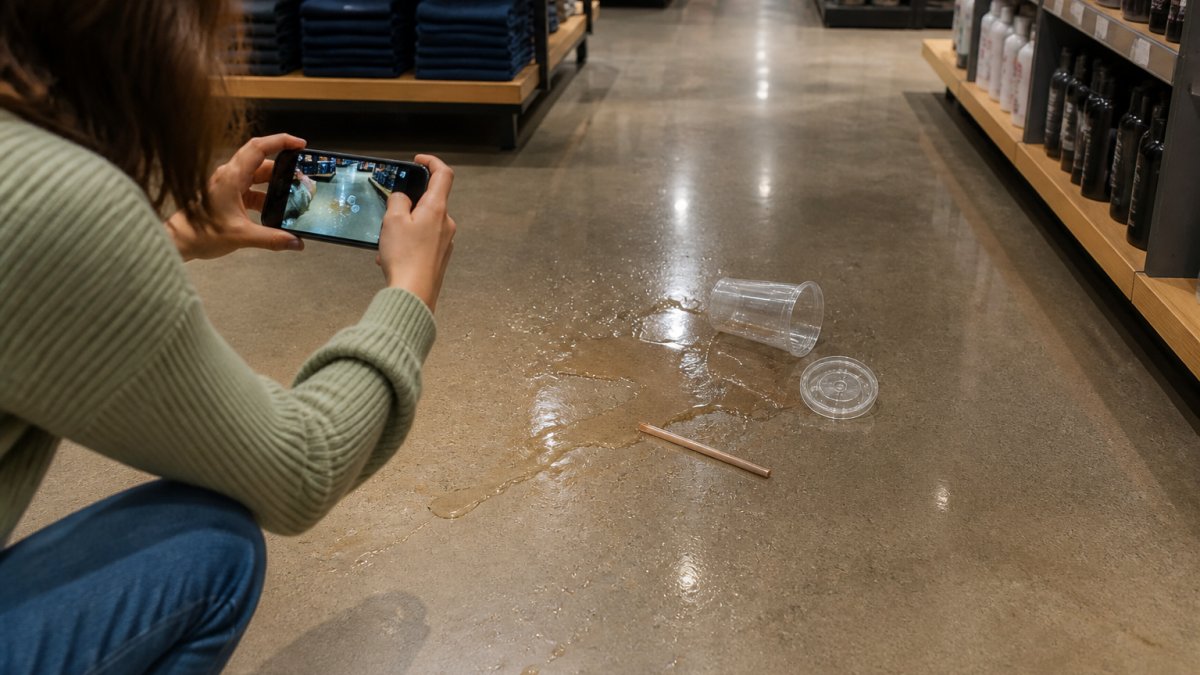
Capture the hazard in context, not just the puddle
A close-up of a spill proves liquid existed. It does not prove the store was on notice, that the area was poorly lit, or that no warning sign was present. Photograph in three passes:
- Wide shot from the aisle entrance showing the full scene, including any “wet floor” signs (or their absence)
- Mid-range shot showing the hazard relative to shelving, endcaps, and traffic paths
- Close-up of the substance, debris, torn carpet, uneven tile, or loose mat
Then capture the conditions a liability adjuster will ask about:
- Overhead lighting and any burned-out bulbs or shadows
- Floor surface type and whether it appeared recently cleaned
- Whether a caution cone, mat, or barrier was present and where it sat
Preserve surveillance footage with a written request
Most retailers run fixed cameras over entrances, aisles, and checkout lanes, and many systems overwrite footage automatically. Verbal requests get lost. Send a written preservation request the same day:
- Identify the store location, date, and approximate time of the fall.
- Ask the manager which cameras cover the aisle where you fell and the surrounding paths.
- Request in writing that all footage from a window beginning at least 30 minutes before the fall be preserved.
- Send the request by email to the store manager and copy the corporate risk-management or legal department.
- Keep the sent email and any reply as proof of the request date.
Do not wait for a lawyer to send this request. Footage that is overwritten on a 7-day cycle may be gone before a retainer is signed. A short, factual email sent the same day is enough to put the store on notice.
Collect witness information while memories are fresh
- Get names, phone numbers, and email addresses from anyone who saw the fall.
- Ask each witness to write a short description of what they saw in their own words.
- Note whether any witness is a store employee, their statement may be the only record of what staff knew before the fall.
Preserve physical evidence and your clothing
- Do not wash the clothes or shoes you wore during the fall.
- Bag them separately and note the date you set them aside.
- If the store offers to replace or clean anything, decline in writing and keep the original item.
Build a contemporaneous timeline
Write down everything from the moment you arrived at the store: time of entry, path through the aisles, time of the fall, who responded, and what was said. Note the date, time, and weather. A timeline written within 24 hours is far more credible than one reconstructed weeks later.
The strongest evidence package is assembled in the first 24 hours: contextual photos, a written surveillance-preservation email, witness statements, unwashed clothing, and a same-day timeline. Everything after that is corroboration.
The most critical evidence disappears fastest, so act within the first hour to capture these key items.
| Evidence Type | Action | Timeline |
|---|---|---|
| Store surveillance footage | Send written preservation request by email | Same day (footage overwrites every 7-30 days) |
| Hazard photographs | Take wide, mid-range, and close-up shots | First hour |
| Witness statements | Collect names, phone numbers, and written descriptions | While memories are fresh |
| Clothing and shoes | Bag separately without washing | Day of fall |
| Injury photographs | Capture from multiple angles as bruising develops | Day of fall and following days |
| Timeline | Write down arrival time, path, fall time, and responses | Within 24 hours |
Know What to Say to a Store After a Fall
Your words matter. What you say to store staff can help or hurt your case.
Say these things:
- “I fell on a wet floor in aisle three”
- “There was no warning sign”
- “I didn’t see the hazard”
Don’t say these things:
- “I’m clumsy” or “I wasn’t paying attention”
- “It’s my fault”
- “I’m fine, don’t worry”
Stick to facts. Describe exactly what happened without opinions or judgments.
Keep conversations brief. You don’t need to explain your whole situation to store staff.
If the store contacts you later, be careful.
Document every conversation. Write down:
- Who you spoke with
- What they said
- What you said
Save all written communication. Keep emails, text messages, and letters from the store or their insurance company.
Document Your Slip and Fall Injury Recovery Time
Track your recovery from day one. This documentation shows how the accident affected your life.
Keep a recovery journal:
- Write down your pain level each day
- Note what activities you couldn’t do
- Record medications you took
Save all medical records:
- Doctor visit notes
- Test results and X-rays
- Physical therapy records
Track your expenses:
- Medical bills
- Transportation to appointments
- Medication costs
Document limitations:
- Days you missed work
- Activities you couldn’t do
- Help you needed from family
Create a spreadsheet to organize this information. Include dates, descriptions, and amounts. This organized record makes it easier to calculate your damages later.
Photographs help too. Take pictures showing how the injury affected your daily life. Show physical therapy, mobility aids, or other evidence of recovery.
Understand Your Legal Rights and Timeline
A slip and fall at a store is a premises liability case. The store has a legal duty to keep the property reasonably safe for customers. If they fail to do this and you’re injured, you may have a claim.
What you need to prove:
- The store owned or controlled the property
- The hazard existed
- The store knew or should have known about the hazard
The store can be liable in two ways. First, if they had actual notice, they knew about the hazard because someone told them or they saw it themselves. Second, if they had constructive notice, they should have known about it because a reasonable property owner would have discovered it through regular inspections.
Deadlines vary, confirm yours immediately
There is no single nationwide deadline for slip and fall claims. Filing deadlines, notice requirements, and claim procedures are set by state law and sometimes by local rules for public entities. A common pattern is a two-year personal injury statute of limitations, but several states use different periods, and claims against government-owned or government-operated properties often require a formal notice of claim within a much shorter window, sometimes 60 to 180 days.
Do not assume the deadline that applies to a friend or a news article applies to you. Confirm the deadline for your situation with a licensed attorney in your state as soon as possible after the fall. Missing it can permanently bar your claim.
When the clock may start later
In some situations the limitations period may not begin on the date of the fall. If an injury does not appear until later, or the connection between the fall and the injury is not reasonably discoverable, a discovery rule may apply in some states. This is fact-specific and varies by jurisdiction, it is not a reason to delay, but it is a reason to get an individualized review rather than relying on a general rule.
What to preserve for the legal analysis
- The incident report number and the manager’s name
- Your written surveillance-preservation request and any reply
- All medical records, bills, and imaging
Insurance contact and early settlement pressure
Insurance companies often contact injured people quickly. Do not agree to anything, sign a release, or give a recorded statement without understanding your rights. Learn more about your legal options with an article on slip and fall store accident claims.
At Abkarian Law Group, we help slip and fall victims understand their rights. Our team knows how stores try to minimize liability. We fight to get you fair compensation for your injuries and losses.
Get a Free Consultation About Your Slip and Fall Claim
After a slip and fall, your next step is talking to a personal injury attorney.
What happens in a consultation:
- You describe the accident and your injuries
- The attorney asks detailed questions
- They explain premises liability law
You don’t pay for a consultation. Most personal injury attorneys work on contingency.
Find out how to file a premises liability claim without a lawyer if you want to handle this yourself.
Get information about how long it takes to receive settlement money so you understand the timeline. Learn what makes a personal injury case valuable to understand how your claim is evaluated.
Contact Abkarian Law Group for a free consultation. Our team is available 24/7.
Frequently Asked Questions
What should I do immediately after a slip and fall at a store?
First, seek medical attention if you are injured. Then notify a store manager or employee about the accident and request that an incident report be completed. Do not leave the store without reporting it. Take photographs of the hazard, the accident scene, and your injuries. Collect the names and contact information of any witnesses. Preserve your clothing and footwear as evidence. Document your symptoms and any medical treatment you receive. These steps protect your legal claim and establish the store’s notice of the unsafe condition.
How long does a slip and fall injury typically take to recover from?
Recovery time varies widely depending on the severity of your injury. Minor sprains or contusions may heal in weeks to a few months, while fractures or more serious injuries can take six months to a year or longer. Some injuries develop delayed symptoms that appear days or weeks after the fall. Keep detailed medical records of all treatment and follow your physician’s recommendations. Document any ongoing pain, limitations in activity, or time away from work, as these factors affect your compensation claim.
What should I include in a store incident report after a fall?
The incident report should include the date, time, and exact location of your fall. Describe the hazard clearly, whether it was a wet floor, spilled liquid, debris, poor lighting, or another unsafe condition. Note whether there was a warning sign in place. List any injuries you sustained. Include the names and badge numbers of store employees who assisted you or witnessed the incident. Do not admit fault or apologize for the fall. Stick to factual statements about what happened. Request a copy of the completed report for your records.
Should I speak with the store’s insurance adjuster after my slip and fall?
You are not required to speak with the store’s insurance adjuster before consulting with an attorney. Insurance adjusters work to minimize the store’s liability, not to protect your interests. Before any conversation with an adjuster, consult with a personal injury attorney who can advise you on what to say and protect your legal rights. An attorney can handle communications on your behalf and ensure you do not say anything that could harm your claim. Do not post about your accident on social media, as this can also be used against you.
A slip and fall at a store can change your life. Medical bills pile up. You miss work. Pain and frustration grow. You deserve compensation from the business that failed to keep you safe. Abkarian Law Group fights for slip and fall victims every day. We handle the legal work so you can focus on recovery. Our bilingual team offers personalized representation with zero upfront costs. Get a free consultation today and learn what your case is worth.
