
Steps to Take After a Minor Car Accident With No Visible Damage
Table of Contents
- Step 1: Check for Injuries and Move to Safety
- Step 2: Documenting a Car Accident Scene When There’s No Visible Damage
- Step 3: Exchange Information and Contact the Police
- California Vehicle Code Accident Reporting Requirements
- Step 4: Notify Your Insurance Provider
- Hidden Car Damage After a Minor Accident: What You Can’t See
- When to Seek Legal Help for a Minor Car Accident
- Frequently Asked Questions
Last Updated: September 16, 2026
Step 1: Check for Injuries and Move to Safety
[After a minor car accident](/what-to-do-after-car-accident-california/), check yourself and your passengers for injuries, then move to safety if the vehicles are drivable. Adrenaline can mask pain, so treat any stiffness, headache, or dizziness as a signal to stop and assess.
If the cars block traffic, pull onto the shoulder or a nearby lot and turn on your hazard lights. If a vehicle won’t move, leave it and get everyone behind a barrier or well off the roadway.
Treating “no visible damage” as proof nothing happened is a mistake, the impact still transferred force through your body. Treating “no visible damage” as proof nothing happened is a mistake, the impact still transferred force through your body. A minor car accident can produce symptoms hours or days later, which is why the injury check comes first.
Never stand between the two vehicles to talk, that’s where secondary collisions happen. Move to the sidewalk or shoulder first.
Step 2: Documenting a Car Accident Scene When There’s No Visible Damage
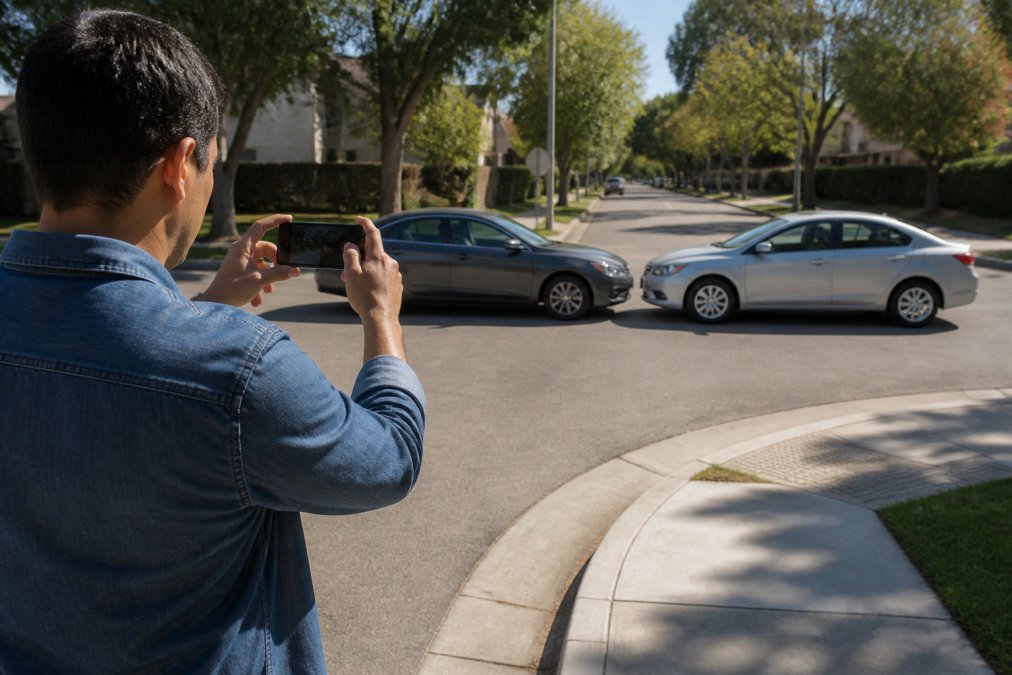
Documenting a car accident scene means capturing vehicle positions, road conditions, and physical evidence before anyone drives away. Even with no visible damage, this record becomes the backbone of an insurance claim months later, when the other driver’s account may have changed.
The Photo Sequence That Covers You
Start wide, then move in, the order establishes context before detail.
- A wide shot from each direction showing both vehicles, lane markings, and the intersection or roadway.
- A mid-range shot from the front, rear, and both sides showing the gap between the vehicles.
- Close shots of all four corners of each vehicle, even where the bumper looks untouched.
- Close shots of license plates, the vehicle identification number visible through the windshield on the driver’s side dashboard, and the other driver’s license and insurance card.
- Ground-level shots beneath and around each bumper.
- Skid marks, debris, fluid spots, and any traffic signals or signs nearby.
Then record a short video walking around both cars while narrating what happened, the time, and the location. The audio gives a timestamped account in your own words.
Photograph the ground beneath and around each bumper, not just the bumpers themselves. Scuffs on the underside, a bent license plate bracket, or fluid spots often reveal hidden car damage after a minor accident that a straight-on photo misses.
Preserving Digital Evidence So It Survives
Photos on a phone are easy to lose or delete. Treat the scene like a file a stranger will review in six months.
- Back up to the cloud the same day. Use a service that timestamps the upload, so the file survives a lost or damaged phone.
- Do not edit, crop, or filter. Edited images invite questions. Keep originals untouched and copy them if you need to zoom.
- Keep the metadata intact. Phones embed capture time and GPS coordinates. Don’t strip it by re-saving through a messaging app, which compresses and removes location data, send originals by email or cloud link.
- Screenshot the timestamp. Capture the photo’s detail view showing date, time, and location, so the metadata is visible even if a copy loses it.
- Write a same-day timeline. A short written account, time, location, weather, what you saw, what was said, created the day of the crash carries more weight than one written a week later.
Dashcam Footage: The Clock Is Running
If you have a dashcam, save the clip immediately. Most record in short loops and overwrite the oldest footage once the card fills, often within hours. Pull the memory card or use the lock function before it’s overwritten.
If a nearby business, residence, or transit vehicle may have captured the collision, note the address and time now. Exterior footage is often overwritten within days, and some businesses release it only to law enforcement or with a subpoena, another reason an official report matters.
What to Do If You Have No Photos
If you didn’t document the scene, you still have options. Return to the location if safe and photograph the roadway, signage, and fixed features.
Evidence you cannot produce is evidence that does not exist. The value of scene documentation is not the moment you take it, it is whether the file is still intact and verifiable when an adjuster or a court asks for it.
Step 3: Exchange Information and Contact the Police
Collect from the other driver:
- Full legal name and current phone number
- Driver license number and state
- Insurance company name and policy number
- License plate and vehicle identification number
- The make, model, and color of the vehicle
What Actually Happens When You Call
Ask the dispatcher two questions before you hang up:
- Will an officer respond to the scene, or should I file a self-report?
- What is the deadline and the office for filing that self-report?
Why the No-Report Path Is the Real Risk
- Both drivers agree it was minor, shake hands, and drive off.
- Ten days later, the other driver visits a clinic and reports neck and back pain.
- Their insurer calls yours and opens a bodily injury claim naming you as the at-fault party.
- Your insurer asks for your account. All you have is your memory and whatever photos you took.
Leaving the scene without any official record is the single biggest risk in a no-damage accident. If the other driver later claims an injury or disputes who was at fault, you have nothing neutral to point to. An officer’s report, or even a self-filed counter report, is far harder to challenge than your own account written after the fact.
::: Establishing this paper trail serves as the foundation for a comprehensive accident response guide that protects your interests long after the initial encounter has concluded.
Hit-and-Run and Unidentified Drivers
If the other driver leaves before you exchange information, treat it as a hit-and-run and call the police immediately.
Save the non-emergency police line for your city in your phone before you need it. In the moment, searching for the right number wastes the minutes when witnesses are still on scene and the other driver is still willing to talk.
California Vehicle Code Accident Reporting Requirements
California law requires drivers to report certain collisions, and the threshold is lower than most people assume.
Step 4: Notify Your Insurance Provider
Notifying your insurer means calling the claims line or filing through the app as soon as practical, even if you don’t plan to claim.
Reporting the accident to your own insurer is not the same as filing a claim against the other driver. Notice protects your coverage; it doesn’t automatically raise your premium or commit you to anything.
Hidden Car Damage After a Minor Accident: What You Can’t See
- The frame and unibody rails for bends
- Suspension and wheel alignment
- Parking sensors, cameras, and radar units mounted in bumpers
- Fluid lines and the radiator support
When to Seek Legal Help for a Minor Car Accident
-
Symptoms that surfaced hours or days after the crash
-
A liability dispute with no independent witnesses
-
An adjuster pushing a recorded statement or a fast, low offer
-
Medical bills that keep growing while the claim sits open
-
Photos and video from the scene
-
Police report number and a copy of the report
-
Other driver’s insurance policy number and contact details
-
Names and numbers of any witnesses
-
Receipts and records for every medical visit
-
A dated log of symptoms as they appear
-
Copies of all correspondence with any insurance adjuster
Frequently Asked Questions
What does it mean when an accident is reported with no damage?
An accident reported with no damage typically means the vehicles involved show no visible dents, scratches, or broken parts. However, this does not mean the incident is legally insignificant. You should still document the scene, exchange information, and notify your insurer. Hidden damage, such as frame misalignment or internal component stress, may not be immediately apparent. Reporting the accident creates a record that can protect you if the other driver later claims an injury or property damage.
Is it necessary to call the police for a minor accident with no damage?
In California, you must report an accident to the police or DMV if it results in injury, death, or property damage exceeding a certain threshold. For a minor accident with no visible damage, calling the police may not be legally required, but it is often wise. A police report provides an official record of the incident, which can be crucial if the other driver later disputes what happened or files a claim. If officers do not respond, you can file a report yourself.
Can internal vehicle damage occur even if there is no visible dent?
Yes, internal damage can occur without any visible dent. The impact of a minor car accident can affect wheel alignment, suspension components, radiator supports, or sensors. You may notice unusual noises, vibrations, or fluid leaks days later. A professional vehicle inspection is the only way to confirm whether hidden damage exists. If you skip this step, you risk driving an unsafe vehicle and facing repair costs that could have been covered by an insurance claim.
How long does a minor accident stay on your driving record?
In California, a minor accident typically stays on your driving record for three years from the date of the incident. However, this can vary depending on whether it was a reportable accident and whether you were found at fault. An at-fault accident may also affect your insurance premium for several years. Consulting with a qualified attorney can help you understand your specific situation and any steps you can take to minimize the long-term impact.
A minor collision with no visible damage can still produce injuries, disputes, and a claim that drags on for months if it isn’t documented properly. Abkarian Law Group offers free consultations, zero upfront costs on personal injury cases, and bilingual representation from a team with over 25 years of trial experience, available around the clock. Get started with Abkarian Law Group and find out what your claim is actually worth before you accept an adjuster’s first offer.