
What Evidence Is Needed for a Car Accident Claim
Table of Contents
- What Evidence Is Needed for a Car Accident Claim: A Timeline for Collecting It
- What to Collect at the Scene
- What to Collect in the First 48 Hours
- Photos to Take After a Car Accident (and Videos That Help)
- Documents Needed for a Car Insurance Claim
- Medical Records for a Car Accident Claim
- How to Preserve Evidence and Get It from Third Parties
- What to Do If You Have No Evidence for a Car Accident Claim
- Conclusion: Building a Claim That Holds Up
- Frequently Asked Questions
Last Updated: October 12, 2026
What Evidence Is Needed for a Car Accident Claim: A Timeline for Collecting It
The evidence needed for a car accident claim falls into five groups: scene photos and videos, witness statements, the police report, medical records, and proof of your financial losses. What you gather in the first 48 hours often decides what your car accident claim is worth months later. (Source: National Highway Traffic Safety Administration (NHTSA))
That window closes fast. Surveillance video overwrites itself. Witnesses forget details. A treating physician’s notes are clearest right after the crash.
Below, we break down what to collect, when, and how to keep it usable, plus what to do when evidence is missing.
The strength of a car accident case usually comes down to timing, not luck. Evidence collected in the first two days is worth more than the same evidence gathered two months later.
What to Collect at the Scene
At the scene, capture what will disappear: photos of every vehicle from multiple angles, then the road, debris, and skid marks.
Next, get names and phone numbers from witnesses before they leave. Exchange insurance and registration details with the other driver, but keep the conversation short.
Call the police and ask for a report; insurers weight it heavily because it is an official record made close to the event.
- Photograph all vehicles, including your own
- Note the location, time, and weather
- Collect witness names and contact information
- Get the other driver’s license plate, insurer, and policy number
- Request a police report number
What to Collect in the First 48 Hours
The first 48 hours are about locking down what already exists before it disappears. Move through this list in order, each item has its own clock.
**1.
2. Save every video file immediately. Dashcams, phone clips, and rideshare or delivery-app footage overwrite on rolling loops, often within 24 to 72 hours.
**3.
**4.
5. Notify your own insurer promptly. Most policies require quick notice, and delay can complicate your claim even when you were not at fault.
**6.
- Order the crash report and check it for errors
- Copy dashcam and phone video to a second location
- Send written preservation requests to anyone with footage
- See a provider and keep every visit summary
- Notify your insurer and decline recorded statements to the other side
- Flag the vehicle data module for preservation
Do not post about the crash on social media. Insurers review public posts, and a casual comment about “feeling fine” can be used to challenge your injuries later. The same applies to photos that show you active or traveling while you claim serious injury.
Build a single folder, physical or digital, for the claim. Drop in the report number, witness contacts, receipts, and every medical visit summary as you get them. A claim that is organized on day two is far easier to prove on day two hundred.
Photos to Take After a Car Accident (and Videos That Help)
Photos to take after a car accident should cover four zones: the full scene, each vehicle, the damage up close, and anything that explains how the crash happened. Wide shots establish position. Close-ups show impact depth.
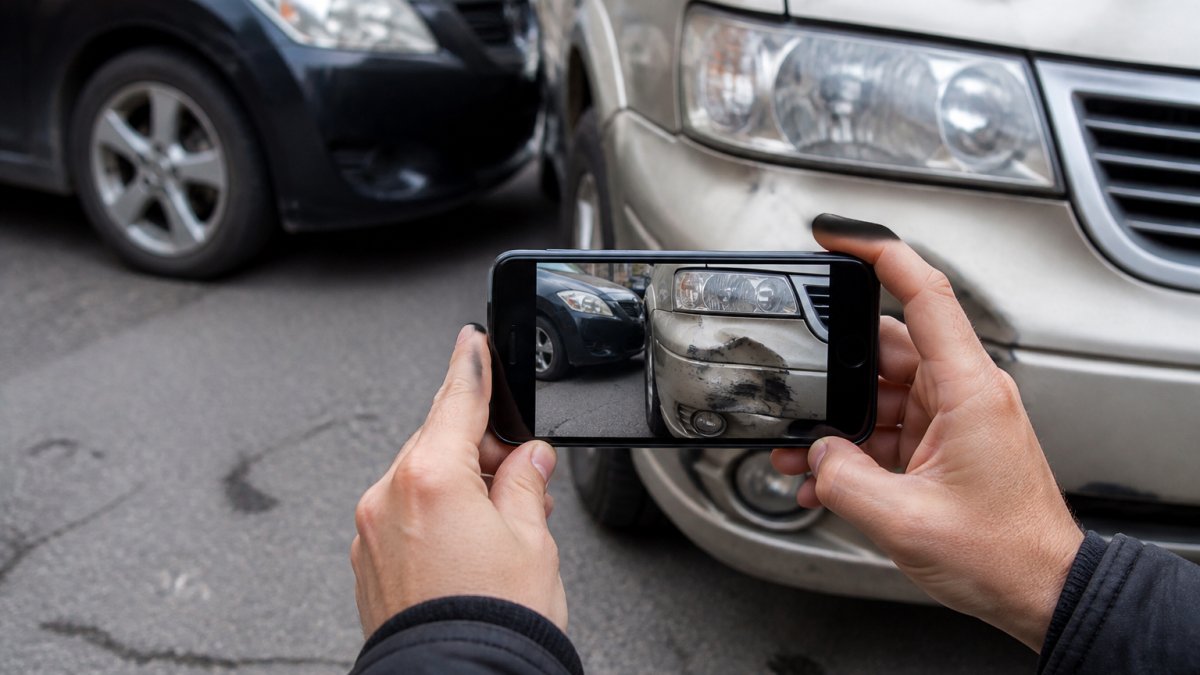
Wide Shots, Close-Ups, and the Angles People Miss
Most people photograph the dent and stop. The angles that matter most show fault.
- Wide shots from several directions, including traffic signals and signs
- Close-ups of scratches, dents, cracked glass, and paint transfer
- Tire marks, debris, and the final resting position of each car
- Streetlights, crosswalks, and road conditions
- Your own visible injuries, photographed the same day
Video helps too: a slow phone walk-around captures context still photos miss. If a dashcam was running, save the file immediately, many systems overwrite footage within days.
Documents Needed for a Car Insurance Claim
The core documents needed for a car insurance claim are the police report, witness statements, repair estimates, and proof of your losses. Insurers build their evaluation on paper, not memory.
Police Reports, Witness Statements, and Contact Information
The police report is often the backbone of a car accident claim, recording the date, location, parties, and the officer’s observations. Request your copy early and check it for errors, since mistakes can follow the case for months.
Witness statements matter just as much. A neutral witness who saw the other driver run a light is far more persuasive than either driver’s account. (Source: National Institute of Neurological Disorders and Stroke (NINDS))
Repair Estimates and Vehicle Value Records
Get at least two written repair estimates from licensed shops. If the car is a total loss, gather pre-crash value records: loan documents, maintenance records, and listings for similar vehicles.
Keep every receipt tied to the crash: towing, storage, and a rental car. These are recoverable property damage and out-of-pocket costs.
| Evidence Type | When to Collect | Why It Matters |
|---|---|---|
| Scene photos and video | Same day | Shows position, damage, and conditions |
| Witness statements | Within 48 hours | Independent proof of fault |
| Police report | Within days | Official record insurers rely on |
| Repair estimates | Within 1-2 weeks | Supports property damage value |
| Medical records | Ongoing | Links injuries to the crash |
Medical Records for a Car Accident Claim
Medical records for a car accident claim turn an accident into an injury case. Without them, insurers treat your claim as property damage only, which rarely justifies a meaningful settlement.
What to Request, and How to Request It
Ask for the complete record, not just the bill. That means:
- Emergency room or urgent care records, including the triage note and discharge instructions
- Diagnostic imaging, X-rays, CT scans, and MRIs, plus the radiologist’s written interpretation
- Every treatment note from follow-up visits, physical therapy, and specialist referrals
- Prescriptions, work excuses, and any recommended restrictions
Most providers release records through a signed authorization form, and many offer a patient portal for self-download. Keep a copy of everything you send and receive. If a provider is slow, a written follow-up usually helps; if not, an attorney can request the records formally.
Why Treatment Gaps Hurt, and How to Close Them
Gaps in treatment are one of the most common ways a car accident case weakens: miss appointments, and the insurer argues you were not seriously hurt. A two- or three-week break between the ER visit and the first follow-up often becomes the centerpiece of that argument.
If you genuinely could not afford care, say so in writing and ask about payment plans or lien-based treatment, where a provider is paid from the eventual settlement. Documenting the reason for a gap beats leaving it unexplained.
Medical Bills, Billing Records, and Liens
Keep every bill, explanation of benefits, and payment receipt. These prove the cost of care and show the treatment was rendered and paid for (or is owed). If a provider or health plan asserts a lien or subrogation right, it must be accounted for in the final settlement, so flag lien notices as soon as they arrive.
Lost Wages and Employment Records
Wage loss is proven with documents, not memory. Gather:
- Pay stubs covering the period before and after the crash
- A letter from your employer stating your rate of pay and the days missed
- Time-off requests, disability paperwork, or FMLA records if applicable
- If you are self-employed, tax returns, invoices, and a schedule showing canceled work
Using Medical Records to Prove Causation When Fault Is Disputed
When the other driver disputes fault or claims you were partly responsible, medical records help establish causation and timing. A record noting the mechanism of injury (for example, “rear-end collision, patient struck from behind”) ties your symptoms to the crash, and consistent complaints across visits, same body part, same description, are harder to attack than one appearing months later. If you had a prior injury to the same area, be upfront with your provider and attorney; a pre-existing condition does not bar recovery, but hiding it damages your credibility.
Medical records serve two jobs at once: they prove the cost of your care, and they prove the care was connected to the crash. Treat every visit summary as evidence, not paperwork.
How to Preserve Evidence and Get It from Third Parties
Preservation is where many claims are quietly lost: nearby business video may be erased in a week, a witness may move, and once evidence is gone it rarely comes back.
Send written preservation requests to businesses, property owners, and anyone holding footage; a short letter asking them to save video from a specific date and time often stops automatic deletion.
For digital evidence, keep the original file and note who captured it, when, and where. Do not edit or crop photos.
If you cannot get records yourself, a lawyer can request them formally. guidance from the National Highway Traffic Safety Administration on crash data can also help you understand what official records exist.
Send preservation letters by email and certified mail. A dated paper trail proves you asked before the footage was deleted, which matters if the other side later claims the video never existed.
What to Do If You Have No Evidence for a Car Accident Claim
No evidence does not mean no claim, it means rebuilding the case from other sources.
Start with official records: a police report, even a brief one, confirms the date and parties; ER records document that you sought care; and vehicle event data (black-box data) may be recoverable from newer cars with a court order.
Then look for indirect proof:
- Nearby businesses with cameras, even if they say no at first
- Traffic camera footage from the city or state
- Phone records showing your location at the time
- Social media posts from others who saw the crash
- Accident reconstruction experts who can work from damage photos
If a witness is now unreachable, an earlier written statement can still be used. If fault is disputed, an attorney can pull records you cannot access alone.
Conclusion: Building a Claim That Holds Up
A car accident claim is only as strong as the evidence behind it, and the clock starts at the crash. Photos, witness details, the police report, medical records, and proof of your losses work together to prove fault and damages.
If you are unsure what you have, or the insurer is already lowballing you, get a second set of eyes on it. At Abkarian Law Group, we offer zero-fee representation on personal injury cases, so you pay nothing upfront.
Frequently Asked Questions
What evidence should I collect after a car accident?
Start with photos and videos of the crash scene, vehicle damage, and any visible injuries. Exchange contact and insurance information with the other driver, and get names and phone numbers from witnesses. Call the police and get a copy of the accident report. Keep all medical records, repair estimates, and receipts. Write down what happened while your memory is fresh. This documentation supports a car accident claim and helps prove fault and damages.
Can I file a car accident claim without a police report?
Yes, you can file a claim without a police report, but it is harder to prove fault. A police report provides an official record of the crash, witness statements, and the officer’s observations. If police did not respond, you can file a report later with the local department. Other evidence like photos, witness testimony, and medical records can still support your car accident claim, though the process may take longer.
What if I don’t have enough evidence for my car accident claim?
Missing evidence does not automatically end your claim. An attorney can help you obtain police reports, subpoena third-party video, request black-box data from vehicles, and gather expert opinions like accident reconstruction. Witnesses may still be located. Even without photos, medical records and property damage estimates can support your case. Acting quickly matters because evidence can disappear or be overwritten.
What documents are needed for a car insurance claim?
Insurers typically ask for the police report, your insurance information, the other driver’s information, photos of the damage, repair estimates, medical bills, and proof of lost wages. You may also need witness statements and a copy of your vehicle title or registration. Keep copies of everything you send. An attorney can help you organize these documents and respond to lowball offers.